
You’ve seen it pop up in a group chat. Maybe someone dropped it in a comment section. Or maybe you overheard someone say it and you just stood there pretending you understood.
“Eno.”
Three little letters. No explanation attached. And somehow, everyone around you seemed to know exactly what it meant.
If you landed here searching for eno meaning slang, you’re not alone. This tiny word has been quietly spreading across texting culture, social media platforms, and casual online conversations and most people who encounter it for the first time are left genuinely confused.
So let’s break the whole thing down. Not with a boring dictionary definition, but with actual context, real examples, and the kind of nuance that most quick-answer articles completely skip over.
So What Does “Eno” Actually Mean in Slang?
Let’s get straight to it.
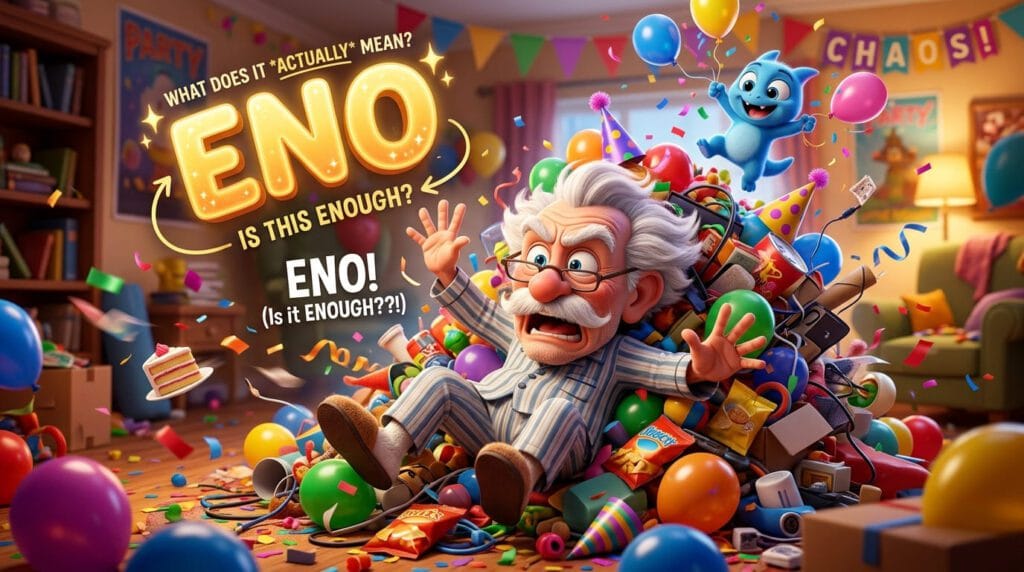
In slang, “eno” means “enough.”
That’s the core of it. When someone types “eno” in a text message, a social media comment, or a casual online conversation, they’re almost always saying enough. I’m done. We’re past this point. Let’s move on.
But here’s the thing that makes this word interesting. It’s not the aggressive kind of “enough.” It’s not someone slamming a door or raising their voice. It’s quieter than that. More resigned. More like a deep exhale after a long conversation that should’ve ended three messages ago.
Think of it as the texting equivalent of closing your eyes, rubbing your temples, and saying “yeah… enough.”
That emotional texture is exactly what separates “eno” from simply typing out the full word “enough.” The abbreviation carries its own specific mood. It’s shorter, cooler, and slightly more detached. And in a world where people communicate primarily through screens, that subtle difference in energy matters more than you’d think.
Where Did This Slang Come From?
Tracking the exact origin of internet slang is always a bit like chasing smoke. By the time you notice it, it’s already everywhere, and nobody can quite point to where the spark started.
What we do know is that “eno” as slang gained traction primarily through texting culture and social media platforms — particularly Twitter (now X), TikTok, Instagram comment sections, and group chats on apps like WhatsApp, iMessage, and Snapchat.
It follows the same pattern as dozens of other slang abbreviations that caught on because they’re fast to type and carry a specific emotional punch. Words like “ngl” (not gonna lie), “imo” (in my opinion), and “icl” (I can’t lie) all went through similar adoption curves. Someone started using the shortened version, other people picked it up because it felt natural, and eventually it crossed from one friend group to the entire internet.
There’s also a regional angle worth mentioning. In some communities particularly in parts of Africa and South Asia — “eno” has been floating around in spoken language for longer than its internet life. It wasn’t always strictly slang in those contexts; it was just how people naturally shortened the word in everyday speech. The internet didn’t invent it. The internet just gave it wings.
The timeline of its wider adoption online seems to track somewhere around 2019 to 2022, when short-form video platforms like TikTok accelerated the spread of micro-slang at a pace that older platforms never could. A creator uses a word in a viral video, viewers adopt it, and within weeks it’s embedded in texting culture across multiple countries.
The Emotional Weight Behind the Word
This is where most articles about eno meaning slang fall short. They give you the definition and move on. But the definition alone doesn’t explain why people choose this word over just typing “enough.”
The reason is tone.
“Eno” carries a very specific emotional signature. It’s not angry. It’s not desperate. It’s not pleading. It’s… done. Calmly, quietly done.
Imagine these two scenarios:
Scenario one: Someone has been going back and forth with a friend about something trivial maybe an argument about whose turn it is to pick the restaurant. After five minutes of pointless debate, one person types: “eno lol just pick wherever.”
That reads as lighthearted. Playful exhaustion. No hard feelings.
Scenario two: Someone has been dealing with ongoing drama maybe a toxic friend who keeps stirring things up. After the latest incident, they post on their story: “eno.”
That reads completely differently. It’s a declaration. A line being drawn. A statement that they’ve reached their limit and they’re stepping back.
Same three letters. Totally different emotional landscape. And people who use this word regularly understand that distinction instinctively. They’re not choosing “eno” because they’re too lazy to type five more letters. They’re choosing it because it sounds different in their head — and by extension, in the reader’s head too.
The Second Meaning When “Eno” Is Actually a Compliment
Here’s something that trips people up, and it’s worth spending some time on.
While the dominant slang meaning of “eno” is “enough” in the sense of I’m done or that’s past the limit, there’s a secondary usage that’s been growing mostly on TikTok and Instagram where “eno” is used as a positive word.
In this version, calling something “eno” means it’s impressive, clean, excellent, or on point.
Think of it like saying “that’s enough said” meaning something was so good it speaks for itself.
Examples of the positive usage:
- “That outfit is eno 🔥” — meaning the outfit is perfect, nothing needs to be added
- “His freestyle was eno fr” — meaning the performance was top-tier
- “The way she handled that? Eno.” — meaning she handled it perfectly
This second meaning is less widespread than the “I’m done” version, and it almost always appears alongside positive emojis, fire symbols, or other contextual clues that signal admiration rather than frustration. Without those clues, most people will default to reading “eno” as the “enough/done” version.
The dual meaning can create genuine confusion, especially for people who are just learning the word. Someone might compliment your work with “that’s eno 🔥” and you might misread it as them saying they’ve had enough of what you’re doing. Context clues — emoji choice, the overall tone of the conversation, the relationship between the speakers become essential for accurate interpretation.
How Context Changes Everything
If there’s one thing to take away from this entire article about eno meaning slang, it’s this: context is not optional. Context is the entire meaning.
The same word, used by the same person, can communicate completely opposite things depending on the situation. And because texting strips away vocal tone, facial expressions, and body language all the things humans normally use to interpret meaning — the burden of clarity falls entirely on surrounding words, emojis, and the shared understanding between the people in the conversation.
Let’s walk through how the same word shifts meaning across different contexts:
| Context | What “Eno” Communicates | Emotional Tone |
|---|---|---|
| Friend group chat, lighthearted argument | “Okay I’m done debating this lol” | Playful, relaxed |
| After someone keeps pushing a sensitive topic | “Stop. I’ve had enough.” | Firm, boundary-setting |
| Reacting to an impressive performance | “That was incredible” | Admiration, praise |
| During a heated argument | “I’m cutting this off” | Cold, potentially hurtful |
| On someone’s social media story with no context | Ambiguous — could be venting | Depends on the viewer’s assumptions |
| Said sarcastically with an eye-roll emoji | “Oh, how impressive” (not really) | Dry, dismissive |
The takeaway here isn’t complicated, but it is important: never assume you know what “eno” means without reading the room first. And if you’re the one using it, be aware that your audience might not read it the way you intended — especially if they don’t know you well.
Real Text Conversations Using “Eno”
Theory is useful. Examples are better. Here’s what “eno” actually looks like in the wild across different types of conversations and relationships.
Conversation 1: The Group Chat Wind-Down
Person A: “Should we do pizza or sushi tonight?”
Person B: “Pizza.”
Person C: “Sushi.”
Person B: “We literally had sushi two days ago.”
Person C: “And it was amazing so let’s do it again.”
Person A: “eno 😭 I’m ordering pizza, come or don’t”
Translation: “I’m done with this debate, I’m making the decision.”
Conversation 2: Setting a Boundary
Person A: “Can we talk about what happened last weekend?”
Person B: “We already talked about it three times.”
Person A: “I just feel like we didn’t resolve—”
Person B: “Eno. Seriously. I need space from this topic.”
Translation: “Enough. I’ve hit my limit and I need this to stop.”
Conversation 3: The Compliment
Person A: posts a clip of their new song
Person B: “bro this is eno 🔥🔥🔥”
Person A: “appreciate that fr 🙏”
Translation: “This is incredible. Nothing more needs to be said.”
Conversation 4: The Sarcastic Version
Person A: “I got employee of the month again 😎”
Person B: “wow eno 🙄”
Translation: “Oh, how impressive” said with maximum dryness and zero genuine enthusiasm.
Conversation 5: The Exhausted Vent
Person A: “My landlord raised the rent AGAIN. Third time this year.”
Person B: “eno. you need to move out of that place honestly”
Translation: “That’s beyond enough. This situation has crossed every reasonable line.”
Conversation 6: The Standalone Post
Someone’s Instagram story, plain black background, white text:
“eno.”
Translation: This could mean almost anything they’re done with a situation, a person, a phase of their life, or maybe just their day. The vagueness is intentional. It invites interpretation without giving specifics.
Where You’ll See It Most Often
If you’re trying to understand where eno meaning slang is most actively used, here’s a realistic breakdown of the platforms and spaces where it shows up regularly:
Text Messages and Group Chats
This is the natural habitat of “eno.” Texting is fast, informal, and emotionally driven exactly the kind of environment where a three-letter word that carries a full mood thrives. You’ll see it most in WhatsApp groups, iMessage threads, and Snapchat conversations.
TikTok
TikTok is where a lot of slang gets amplified. Creators use “eno” in video captions, comment sections, and voiceovers. The positive “that’s eno 🔥” usage seems particularly common here, likely because TikTok’s culture rewards short, punchy reactions.
Twitter / X
The character limit on Twitter has always made it fertile ground for abbreviations and compressed language. “Eno” fits perfectly into tweet-length reactions and quote tweets.
Mostly in comment sections and stories. The standalone “eno.” story post black background, white text, no further explanation — has become its own mini-genre of vague emotional expression.
Discord and Gaming Chats
Gamers and online communities on Discord use “eno” in real-time conversations, particularly when someone is being annoying, a match has gone badly, or the group needs to move on from a topic.
Less common here, partly because Reddit conversations tend to be longer and more detailed. But you’ll see it in casual subreddits and in threads where younger users dominate the conversation.
When You Should Absolutely Not Use “Eno”
Knowing a word is only half the skill. Knowing when not to use it is the other half and arguably the more important one.
Here are specific situations where dropping “eno” is likely to go badly:
Professional Communication
Your work Slack, your email to a client, your message to your manager none of these are appropriate places for “eno.” Even if your workplace culture is relaxed, slang like this reads as either confusing or unprofessional. Most people in professional settings won’t know what it means, and those who do will wonder why you’re using it at work.
During Serious Emotional Conversations
If someone is opening up about something genuinely painful a breakup, a family crisis, a mental health struggle — responding with “eno” can feel devastatingly cold. Even if you mean it supportively (like “you’ve been through enough”), the brevity of the word strips it of the warmth you’re trying to convey. In these moments, use more words. Be explicit about your care.
With People Who Don’t Know the Slang
This sounds obvious, but it catches people off guard constantly. If you’re talking to someone who isn’t plugged into internet slang culture older relatives, international colleagues, people who just aren’t online that much”eno” will either confuse them or get misinterpreted. With certain demographics, they’ll think you’re talking about the antacid brand, which creates a completely different conversation.
In Public Comments on Sensitive Topics
Dropping “eno” in the comment section of a post about a serious social issue, a tragedy, or someone’s genuine vulnerability reads as dismissive even if that wasn’t your intention. Public comments lack the personal context that makes slang safe between friends.
When You’re Already in a Conflict
If things are tense between you and someone else, “eno” can function as a verbal slap. It communicates “I don’t care enough about this to keep engaging,” which even if it’s how you genuinely feel tends to escalate rather than resolve conflict. If you need to disengage, say so with enough words that your intention is clear.
Eno vs. Emo The Mix-Up That Keeps Happening
This confusion comes up far more often than you’d expect, and it’s worth addressing directly.
“Eno” and “emo” are completely unrelated words. They share two out of three letters, which is enough to trip up anyone who encounters one or both of them for the first time. But they come from entirely different worlds.
Emo is a music genre and cultural aesthetic that originated in the 1980s, peaked in mainstream visibility in the mid-2000s, and carries a very specific visual and emotional identity think emotional punk rock, dark eyeliner, side-swept hair, bands like My Chemical Romance and Dashboard Confessional. “Emo” is short for “emotional,” and while it’s sometimes used loosely to describe someone who’s being overly dramatic or sad, its roots are firmly in a specific music and subculture movement.
Eno in slang has no connection to the emo subculture whatsoever. It doesn’t reference the music, the aesthetic, or the emotional tone associated with emo. It’s simply a shortened version of “enough” that caught on independently.
The confusion is purely visual the letters look similar on a screen. But if you accidentally call something “emo” when you mean “eno” (or vice versa), you’ll communicate something wildly different from what you intended.
Quick distinction to remember:
- Emo = emotional, related to a music genre and subculture
- Eno = enough, related to reaching a limit or (sometimes) expressing admiration
Is “Eno” a Gen Z Thing?
The honest answer is: mostly, but not entirely.
The slang usage of “eno” is most common among Gen Z and younger Millennial internet users. These are the demographics that drive most online slang adoption, and “eno” follows the same pattern as other abbreviations that gained popularity through social media and texting.
But calling it exclusively Gen Z slang oversimplifies things.
First, as mentioned earlier, “eno” as a spoken shortening of “enough” has existed in various communities and dialects long before it became an internet trend. In some African and South Asian linguistic contexts, shortening “enough” to something that sounds like “eno” is just natural speech. The internet didn’t create this word from nothing it adopted and amplified something that already existed in certain corners of spoken language.
Second, the antacid brand Eno has been a household name across multiple generations in countries like India, Pakistan, Nigeria, and several others. For people in those regions regardless of age”eno” has a completely separate primary meaning. A grandmother in Lahore and a teenager in Lagos might both know the word “eno” but mean entirely different things when they say it.
So while the slang-specific usage skews younger, the word itself doesn’t belong to any single generation. Where someone grew up, what languages they speak, and how connected they are to internet culture all shape what “eno” means to them.
Other Meanings of “Eno” Outside Slang
Since you’re here for the eno meaning slang explanation, we’ve spent most of this article there. But it’s worth briefly acknowledging the other meanings of “eno” that exist outside of texting culture because you will inevitably encounter them, and understanding the full landscape prevents confusion.
Eno Fruit Salt The Antacid
Eno is a well-known brand of antacid powder manufactured by GlaxoSmithKline. It’s been around since the 1850s and remains widely popular in South Asia, Africa, and parts of South America. You mix a spoonful with water, it fizzes, and it provides quick relief from acidity, heartburn, and stomach discomfort. If someone older in your family tells you to “take some Eno,” they’re not speaking in slang they’re offering you a digestive remedy.
Brian Eno The Music Producer
In music circles, “Eno” almost universally refers to Brian Eno, the British musician and producer who is credited with pioneering ambient music and revolutionizing music production. He has worked with artists like David Bowie, Talking Heads, U2, and Coldplay. His influence on modern music is so profound that music enthusiasts refer to him by his surname alone, the same way people say “Hendrix” or “Bowie.”
ENO Medical Acronym
In clinical and respiratory medicine, ENO stands for Exhaled Nitric Oxide. It’s a diagnostic measurement used primarily in asthma management to assess airway inflammation levels. Doctors use fractional exhaled nitric oxide (FeNO) testing to guide treatment decisions.
ENO English National Opera
In the arts and cultural world, ENO refers to the English National Opera, a London-based opera company distinguished by its commitment to performing operas in English rather than their original languages. This approach has made opera more accessible to English-speaking audiences since the company’s establishment.
Common Misconceptions People Have About “Eno” Slang
Let’s clear up some things that frequently get misunderstood:
“It’s always negative”
Not true. The complimentary usage where “eno” means something is impressive or perfect is real and growing. If someone pairs “eno” with fire emojis and obvious enthusiasm, they’re praising you, not shutting you down.
“It’s the same as saying ‘enough’ in any situation”
Not quite. “Eno” carries a specific casual, internet-native tone that the full word “enough” doesn’t always have. Saying “enough” in a serious conversation is direct and clear. Saying “eno” in the same conversation might come across as flippant or emotionally detached. They’re related but not interchangeable in every context.
“It’s universal slang that everyone understands”
Far from it. “Eno” is still relatively niche compared to more established slang like “lol,” “ngl,” or “fr.” Plenty of internet users including active social media users have never encountered it or don’t know what it means. Assuming universal comprehension is a fast track to miscommunication.
“It’s just lazy typing”
This one is dismissive and inaccurate. People who use “eno” aren’t too lazy to type “enough.” They’re choosing a word that carries a different emotional register. Slang isn’t laziness — it’s linguistic evolution happening in real time. Every generation develops its own shorthand, and “eno” is simply part of this generation’s contribution to informal language.
“It’s disrespectful by default”
The word itself is neutral. Like any piece of language, its impact depends entirely on delivery, timing, and relationship. Between close friends, “eno” is affectionate and comfortable. Between strangers or in the wrong moment, it can sting. The word isn’t the problem the application sometimes is.
How to Respond When Someone Says “Eno” to You
This is a practical section that most articles skip, but it’s genuinely useful especially if you’re new to the word and suddenly someone has used it in a conversation with you.
If it’s clearly the “I’m done” version:
Respect the boundary. Whether they’re done with a conversation topic, done with an argument, or done with a situation, “eno” is someone signaling that they’ve reached their limit. The best responses are usually:
- Acknowledging it: “Fair enough, we’ll drop it.”
- Matching their energy: “Yeah, eno from me too honestly.”
- Giving space: Simply moving on to a different topic without making a big deal of it.
What you generally shouldn’t do is push back or demand more conversation after someone has said “eno.” That tends to escalate things.
If it’s the complimentary version:
Accept the compliment. If someone says your work, your outfit, your performance, or your anything is “eno” and the context clues (emojis, tone, enthusiasm) support that reading they’re telling you it’s on point. A simple “appreciate that 🙏” or “thank you fr” works perfectly.
If you’re genuinely not sure what they mean:
Ask. Seriously, just ask. There is no shame in saying “wait, eno as in enough or eno as in it’s good?” Most people will clarify without judgment. Guessing wrong and reacting based on the wrong interpretation creates way more awkwardness than just asking for clarity.
If it feels sarcastic or passive-aggressive:
Trust your instincts but don’t react impulsively. If “eno” is paired with a 🙄 emoji or dropped in a way that feels pointed, it might be sarcastic. Before you respond with heat, consider whether the person might just be dry in their humor. If it genuinely feels hostile, you can address it directly: “Hey, what do you mean by that?” Getting clarity is always better than assuming the worst and escalating.
Frequently Asked Questions About Eno Meaning Slang
Is “eno” considered rude?
Not inherently. The word itself is neutral. Whether it comes across as rude depends entirely on the situation, the relationship between the people communicating, and the emotional context surrounding the conversation. Between friends who share a comfortable dynamic, “eno” is casual and harmless. In sensitive moments or with people who don’t know you well, it can land as dismissive or cold. The word doesn’t decide its impact the moment does.
Can “eno” be used sarcastically?
Absolutely. Like almost any slang term, “eno” can be weaponized with sarcasm. An eye-roll emoji, a flat tone, or a context that clearly doesn’t warrant genuine admiration can all flip “eno” from sincere to cutting. “Oh wow, eno 🙄” is a very different message from “that was eno 🔥.” If you’re on the receiving end and something feels off, pay attention to those surrounding signals.
Does “eno” mean the same thing in every country?
Not at all. In countries where the Eno antacid brand has been a staple for decades India, Pakistan, Bangladesh, Nigeria, and others the word “eno” first and foremost refers to the digestive powder. The slang meaning exists alongside this but doesn’t replace it. A young person in Mumbai might use “eno” both ways depending on whether they’re texting a friend or talking to their grandmother. Geography, generation, and cultural context all shape which meaning comes to mind first.
Is “eno” in the dictionary?
As slang, no not in standard dictionaries like Merriam-Webster or Oxford. It appears in crowd-sourced slang dictionaries like Urban Dictionary, where users submit and upvote definitions. The antacid brand “Eno” is a trademarked product name. Brian Eno appears in music encyclopedias and biographical references. But the slang usage hasn’t crossed the threshold into formal lexicography yet, which is normal for internet slang most of these words exist in active use for years before any dictionary acknowledges them.
What’s the difference between “eno” and “enuf”?
Both are informal spellings of “enough,” but they carry slightly different vibes. “Enuf” is a more straightforward phonetic respelling — it reads more like deliberate casual spelling (similar to “tho” for “though” or “nite” for “night”). “Eno” has evolved beyond simple respelling into its own word with its own emotional texture and secondary meanings. They overlap but aren’t identical in usage or feeling.
Can I use “eno” in a job interview or formal setting?
Please don’t. Slang of any kind is generally inappropriate in formal, professional, or academic settings. “Eno” specifically carries the additional risk of being unknown to your audience, which means it won’t just sound casual — it might sound like you’re speaking a different language entirely. Keep it in your texts, your group chats, and your social media. Leave it out of your resume, your cover letter, and your meeting with HR.
How do I know if someone is using “eno” positively or negatively?
Look at the full message, not just the word. Positive usage typically comes with fire emojis 🔥, enthusiastic language, exclamation marks, or obvious admiration. Negative or neutral usage tends to stand alone, pair with more subdued emojis (or none at all), or appear in conversations where frustration or exhaustion is already present. When in doubt, look at what was said before and after “eno” — the surrounding messages almost always make the intention clear.
Is “eno” slang going to last or is it a passing trend?
Hard to say with certainty, but it has a few characteristics that suggest staying power. It’s short, versatile, emotionally expressive, and fills a genuine gap in casual communication. Words like “vibe,” “salty,” and “lowkey” were once considered passing trends too, and they’ve embedded themselves firmly in everyday language. “Eno” may not reach that level of universality, but it’s shown enough resilience and organic adoption to suggest it won’t disappear overnight. Whether it becomes permanent vocabulary or fades into the background like thousands of other micro-slang terms remains to be seen.
Final Thoughts Three Letters, A Lot of Layers
If you came here looking for the eno meaning slang, here’s the simplest possible summary: it means “enough.” Sometimes in a tired way, sometimes in an admiring way, and always in a way that depends heavily on who’s saying it, who’s hearing it, and what’s happening around it.
But reducing “eno” to a single definition misses what makes slang fascinating in the first place. Words like this don’t just communicate information — they communicate feeling. And feelings are messy, contextual, and deeply human.
“Eno” works in texting culture because it captures something that longer phrases can’t quite replicate. It’s the exhaustion of a conversation that went on too long. It’s the admiration for something that doesn’t need a paragraph of praise. It’s the boundary someone draws when they’ve run out of patience. It’s a whole emotional statement compressed into three lowercase letters.
And that compression is exactly what makes modern slang so effective — and so easy to misread.
So use it if it fits your communication style. Skip it if it doesn’t. But now that you understand what it means, how it works, and where it can go wrong, you’re equipped to handle it no matter which direction it comes from.
The next time “eno” shows up in your notifications, you won’t need to Google it.
You’ll just know.