
So you’re scrolling through your messages, reading through a group chat, or diving deep into a TikTok comment section when suddenly someone drops “OML” into the conversation. You pause. You squint at your screen. You think to yourself, “Wait… what does that even mean?”
Don’t worry. You’re definitely not the first person to scratch their head over this one, and you certainly won’t be the last. The world of internet slang moves at lightning speed, and keeping up with every abbreviation, acronym, and shorthand expression can feel like learning a whole new language.
Here’s the short answer right off the bat: OML stands for “Oh My Lord.” It’s a quick, emotionally charged expression people use when they’re surprised, shocked, amused, frustrated, or just plain overwhelmed by something. Think of it as a close cousin to “OMG” but with its own unique flavor and vibe.
But there’s so much more to this tiny three-letter acronym than just its definition. How do people actually use it in real conversations? Does it carry different meanings on different platforms? Is it appropriate in every situation? How should you respond when someone texts you “OML”?
Stick around, because we’re about to break all of that down in the most thorough, easy-to-understand guide you’ll find anywhere. By the time you finish reading this, you’ll not only understand what OML means you’ll know exactly how to use it like a pro.
What Does OML Actually Mean in Text?
Let’s start from the very beginning and make sure we’ve got this crystal clear.
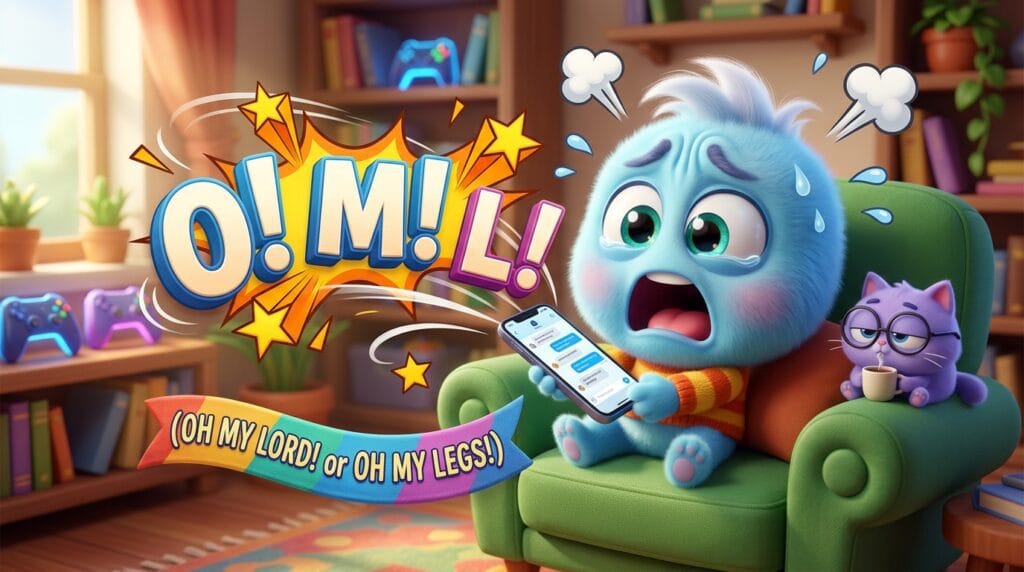
OML = Oh My Lord
That’s it. That’s the core meaning. When someone types “OML” in a text message, a social media comment, a direct message, or any kind of digital conversation, they’re essentially saying “Oh My Lord” in an abbreviated form.
Now, the phrase “Oh My Lord” itself is an exclamation. It’s something people say out loud when they experience a strong emotional reaction to something. Maybe they just heard unbelievable news. Maybe they witnessed something hilarious. Maybe they’re frustrated beyond belief. Whatever the case, “Oh My Lord” and by extension, “OML” is a way of expressing that rush of emotion in just three little letters.
Here’s a quick breakdown of the technical details:
- Full form: Oh My Lord
- Type: Acronym / Internet slang
- Category: Exclamation / Interjection
- Tone: Informal, casual, expressive
- Emotional range: Surprise, excitement, shock, amusement, frustration, disbelief
- Primary audience: Teenagers, young adults, social media users
- Platforms where it’s most common: TikTok, Snapchat, Instagram, WhatsApp, iMessage, Twitter/X
One thing that’s important to understand is that OML is versatile. It doesn’t carry just one emotion. The exact feeling it conveys depends entirely on the context of the conversation. We’ll explore all those different tones and contexts later in this guide, but for now, just remember: OML is an emotional amplifier. Whatever someone is feeling, adding OML to their message turns the volume up.
Why Do People Use OML Instead of Typing the Full Phrase?
This is a fair question, and it gets to the heart of how modern digital communication works.
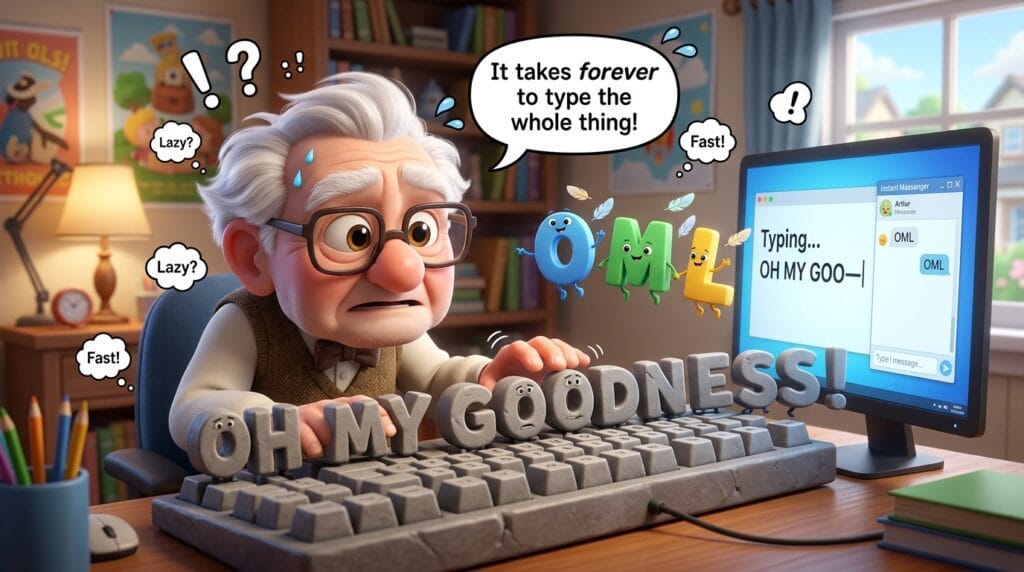
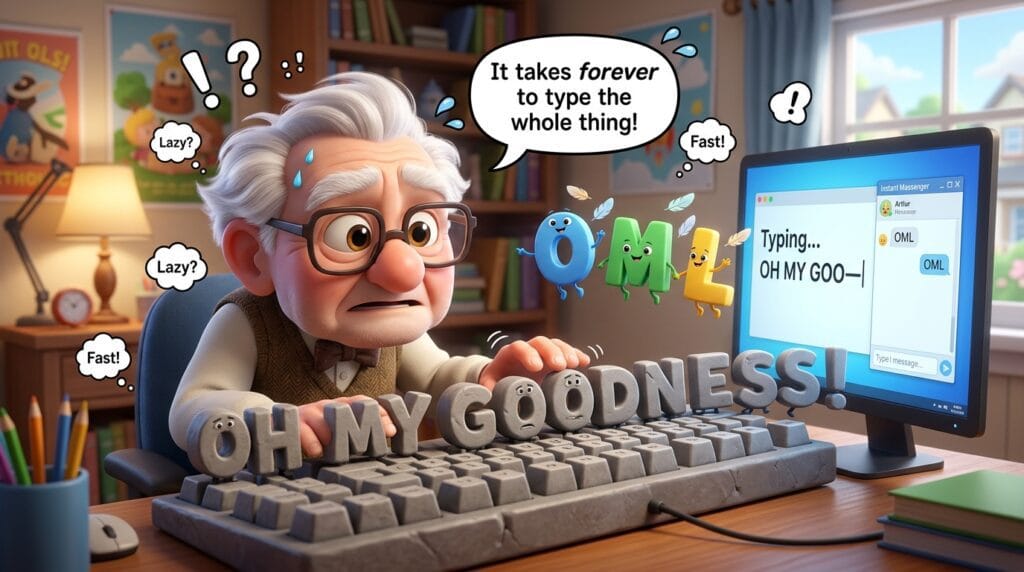
Think about it. When you’re texting someone or replying to a comment on TikTok, speed matters. Nobody wants to type out “Oh my lord, I cannot believe what just happened” when they can convey essentially the same reaction with three letters and maybe an emoji. The whole point of internet slang is efficiency combined with expressiveness.
Here are the main reasons OML became so popular:
1. Speed and Convenience
In a world where conversations happen in real time whether it’s a rapid-fire group chat or a live reaction to a video — typing speed matters. OML is faster than writing out the full phrase. It lets you react immediately without slowing down the flow of conversation.
2. Emotional Punch in a Small Package
There’s something about abbreviations like OML that feel more impactful than writing out the full phrase. It’s like the difference between saying “wow” and saying “WOW.” The abbreviation itself has become a form of expression, not just a shortcut. When someone sees OML in a message, they immediately understand the emotional weight behind it.
3. Cultural Identity and Belonging
Using internet slang is also about fitting into a community. When you use terms like OML, you’re signaling that you’re part of the digital conversation. You understand the language. You belong. For younger generations especially, slang is a way of connecting with peers and expressing identity.
4. Character Limits and Platform Constraints
On platforms that have character limits or where brevity is valued (like Twitter/X or TikTok comments), short expressions like OML are practically necessary. Why use twelve characters when three will do the job?
5. It’s Just Fun
Let’s be honest — using slang is fun. It makes conversations feel lively, casual, and authentic. Nobody wants to text like they’re writing a formal letter. OML adds personality to messages in a way that full sentences sometimes don’t.
The Origin Story of OML
Now, you might be curious about where OML actually came from. Was there a specific moment when someone invented it? Did it emerge from a viral meme? Let’s dig into the history.
The OMG Connection
To understand OML, you first need to understand its older, more famous sibling: OMG (Oh My God). OMG has been a staple of internet communication since the early days of texting and instant messaging. It was one of the original text abbreviations, and it became so widespread that the Oxford English Dictionary officially added it in 2011.
OML likely emerged as a variation of OMG. Some people preferred saying “Oh My Lord” instead of “Oh My God” for various reasons — sometimes religious sensitivity, sometimes personal preference, sometimes just to be different. As this spoken preference carried over into texting, the abbreviation OML was born.
The Rise of Fast-Typing Culture
The early 2010s saw an explosion of texting slang. With the rise of smartphones and messaging apps, people began communicating through text more than ever before. This created a need for quick, punchy expressions that could convey complex emotions in just a few keystrokes. OML fit perfectly into this ecosystem.
Social Media Amplification
The real boost for OML came with the rise of platforms like Snapchat, Instagram, and especially TikTok. These platforms thrive on rapid reactions and short-form content. When millions of users needed a quick way to express shock or surprise in comments and messages, OML became a natural choice.
Meme Culture and Viral Spread
Meme culture also played a role. As OML started appearing in viral TikTok comments and Twitter threads, it gained momentum. People who had never used the term before started picking it up simply because they saw others using it. That’s how slang works — it spreads through exposure and imitation.
Timeline of OML’s Evolution
| Period | Development |
|---|---|
| Early 2000s | OMG dominates texting slang |
| Late 2000s–Early 2010s | Variations like OML begin appearing in niche online communities |
| Mid 2010s | Snapchat and Instagram popularize OML among younger users |
| Late 2010s–2020s | TikTok’s explosive growth makes OML mainstream |
| 2024–2026 | OML is a widely recognized and frequently used internet acronym |
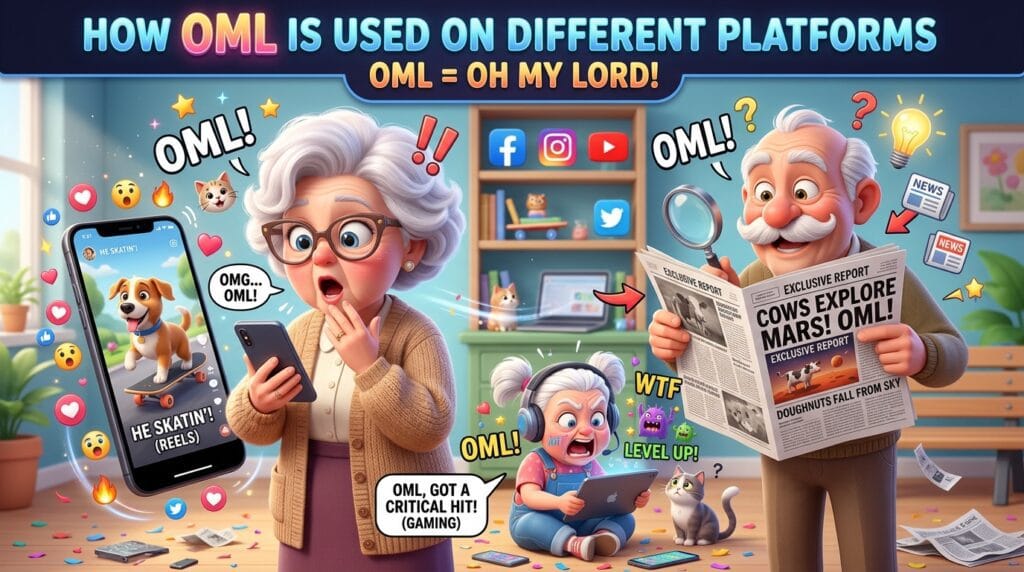
How OML Is Used on Different Platforms
One of the fascinating things about OML is that while its core meaning stays the same across platforms, the way people use it and the context surrounding it can vary quite a bit. Let’s walk through the major platforms one by one.
OML on Snapchat
Snapchat is all about quick, ephemeral communication. Messages disappear, snaps are temporary, and the whole vibe is casual and spontaneous. OML fits right into this environment.
On Snapchat, you’ll most commonly see OML in:
- Direct snaps: Someone sends you a snap of something wild or unexpected, and you reply with “OML 😂”
- Chat messages: Quick back-and-forth conversations where OML serves as an instant reaction
- Story replies: When someone posts a story that’s funny, surprising, or dramatic, OML is a go-to response
- Streak conversations: Those daily snap exchanges with close friends often include casual slang like OML
Example Snapchat conversation:
Friend: sends a snap of their cat knocking over a glass of water
You: “OML your cat is a menace 😭”
The tone on Snapchat is almost always playful and lighthearted. OML here is usually about humor and casual shock rather than genuine distress.
OML on TikTok
TikTok is arguably the platform where OML gets the most visibility. With billions of comments posted every day on millions of videos, quick reaction phrases are essential. OML is one of the most popular.
On TikTok, you’ll find OML in:
- Comment sections: This is the big one. When a video surprises, amuses, or shocks viewers, the comments flood with expressions like OML
- Video captions: Creators sometimes use OML in their captions to set the tone for their content
- Duet and stitch reactions: When creators react to other videos, OML often appears in their spoken or written reactions
- Live stream chats: During live broadcasts, viewers type OML to react in real time
Example TikTok comment scenario:
Video shows someone’s incredible home renovation before and after
Comment: “OML the transformation is insane 🤯”
On TikTok, OML tends to carry a high-energy, enthusiastic tone. It’s about being impressed, amused, or amazed.
OML on Instagram
Instagram offers multiple formats for communication posts, stories, reels, DMs, and comments and OML shows up in all of them.
- Comments on posts: When someone posts a stunning photo, a shocking revelation, or a funny meme, OML appears frequently in the comments
- Direct messages: Private conversations on Instagram often include OML as a reaction to shared content or personal news
- Story reactions: Instagram’s story feature allows quick replies, and OML is a natural fit for expressing surprise or excitement
- Reel comments: Similar to TikTok, Instagram reels generate lots of quick reactions where OML is common
Example Instagram DM:
Friend: “I just got accepted into my dream university!”
You: “OML ARE YOU SERIOUS?! Congratulations!! 🎉🎉”
On Instagram, OML can range from casual to deeply enthusiastic, depending on the relationship between the people communicating.
OML on WhatsApp
WhatsApp is where things get a bit more personal. Unlike public platforms like TikTok or Instagram, WhatsApp conversations are typically private between two people or within a closed group. This means OML on WhatsApp often carries more personal weight.
- One-on-one chats: Friends and family use OML to react to news, gossip, updates, or shared media
- Group chats: In family groups, friend groups, or hobby groups, OML is a common reaction when someone drops unexpected news
- Voice message follow-ups: Sometimes people type OML as a quick response before sending a longer voice message
Example WhatsApp group chat:
Mom: “Your cousin is getting married next month!”
You: “OML, that’s so sudden! Who’s the lucky person?”
Sister: “OML I didn’t even know she was seeing someone!”
On WhatsApp, the tone tends to be genuine and conversational. It’s less performative than on public platforms and more reflective of real emotional reactions.
OML in Regular Text Messages (SMS/iMessage)
Good old-fashioned texting is where abbreviations like OML originally thrived. Even with all the fancy apps available today, plenty of people still communicate primarily through SMS or iMessage.
In text messages, OML works exactly as you’d expect:
Friend: “I accidentally sent a meme to my boss instead of you.”
You: “OML 💀 what did they say?!”
Text message OML tends to be straightforward and conversational. There’s no audience, no performance just two people reacting to life in real time.
OML on Twitter/X
On Twitter (now X), where brevity has always been valued, OML shows up in:
- Quote tweets: Reacting to someone else’s tweet with shock or surprise
- Replies: Responding to breaking news, viral tweets, or controversial takes
- Original tweets: Sharing personal stories or reactions
Example tweet:
“OML I just found out my flight is delayed by 6 hours. This day keeps getting better 🙃”
On Twitter/X, OML can be sarcastic, genuine, frustrated, or amused the platform’s culture embraces all tones.
OML on Discord
Discord servers are hubs for communities built around gaming, hobbies, fandoms, and more. OML is a natural part of Discord chat because the communication style is fast, informal, and expressive.
Server member: “The new game update just dropped and it’s MASSIVE”
You: “OML downloading it right now”
On Discord, OML tends to be casual and enthusiastic, matching the energetic vibe of most server conversations.
OML on Reddit
Reddit is a bit different from other platforms because conversations tend to be more detailed and thoughtful. Still, OML shows up in casual subreddits, comment threads, and informal discussions.
Post: “I accidentally called my teacher ‘Mom’ today.”
Comment: “OML the secondhand embarrassment is real 😂”
The Many Tones of OML: Context Matters
Here’s something crucial that a lot of people miss when learning about internet slang: the same word or phrase can mean very different things depending on how it’s used. OML is a perfect example of this. The three letters stay the same, but the emotion behind them can shift dramatically based on context, punctuation, capitalization, and accompanying emojis.
Let’s explore all the different tones OML can carry.
The Surprised Tone
This is probably the most common use of OML. Something unexpected happened, and you need to express your shock.
A: “I just found out I’m having twins.”
B: “OML, twins?! That’s amazing!”
The surprised OML is wide-eyed, mouth-open, genuine astonishment. It’s the digital equivalent of gasping.
The Excited Tone
When something wonderful happens and you can barely contain your joy, OML becomes an exclamation of pure excitement.
A: “We got front-row tickets to the concert!”
B: “OML YES!! I’m literally screaming right now!”
Excited OML is usually accompanied by exclamation marks, capital letters, and enthusiastic emojis like 🎉, 🔥, or 😍.
The Humorous Tone
Something funny happened, and OML is your way of laughing along. This is extremely common in group chats and TikTok comments.
A: “My grandma just asked me what ‘rizz’ means.”
B: “OML 😂😂 what did you tell her?”
Humorous OML is light, fun, and usually paired with laughing emojis or the skull emoji (💀), which represents “I’m dead” (from laughing).
The Frustrated Tone
Sometimes OML isn’t about joy or surprise it’s about exasperation. When something annoying or infuriating happens, OML can express that frustration perfectly.
A: “The wifi went out again right before my deadline.”
B: “OML, seriously?! That’s the worst timing.”
Frustrated OML might be followed by complaining, venting, or sympathetic responses. The tone is still informal, but the emotion behind it is negative rather than positive.
The Sarcastic Tone
Sarcasm is a huge part of internet culture, and OML is no stranger to it. When someone says something ridiculous, unbelievable, or obviously false, a sarcastic OML can cut through the noise.
A: “I’m going to start waking up at 5 AM every day to work out.”
B: “OML, sure you will 🙄”
Sarcastic OML often comes with the eye-roll emoji (🙄) or a dismissive follow-up. The key is that the person using it doesn’t actually believe or isn’t genuinely impressed by what was said.
The Romantic or Flirty Tone
In the right context, OML can become a tool for expressing romantic feelings, flattery, or flirtation.
A: sends a dressed-up selfie “Ready for tonight!”
B: “OML 😍 you look absolutely incredible”
Romantic OML is warm, admiring, and usually accompanied by heart-eyes (😍), hearts (❤️), or fire emojis (🔥).
The Dramatic Tone
Some people use OML to be deliberately over-the-top. It’s not that they’re genuinely shocked they’re performing drama for comedic effect.
A: “We’re out of ice cream.”
B: “OML, this is the worst day of my entire life 😩”
Dramatic OML is all about exaggeration. The situation doesn’t warrant a strong reaction, but the person cranks it up to eleven for humor.
The Sympathetic Tone
When someone shares bad news or a difficult situation, OML can express genuine sympathy and concern.
A: “My car broke down on the highway this morning.”
B: “OML, that sounds terrible. Are you okay? Do you need help?”
Sympathetic OML is gentler and usually followed by offers of support or expressions of concern.
The Impressed Tone
When someone shows you something remarkable an achievement, a skill, a creation OML can express admiration and being impressed.
A: shares a painting they’ve been working on for months
B: “OML, you painted that?! That’s gallery-worthy!”
Impressed OML is enthusiastic and validating. It lifts the other person up and acknowledges their accomplishment.
The Overwhelmed Tone
Sometimes life throws so much at you that all you can say is OML. It’s not specifically positive or negative it’s just a lot.
A: “So basically, my car broke down, my phone died, and I locked myself out of my apartment all in the same day.”
B: “OML… that is an absolutely brutal day.”
Overwhelmed OML carries a sense of “I don’t even know where to begin processing this.”
25+ Real-Life Chat Examples Using OML
The best way to truly understand how OML works in real conversations is to see it in action. Here are over 25 examples across different scenarios and tones.
Everyday Surprise
A: “I just ran into our high school teacher at the grocery store.”
B: “OML, that’s so random! How did they look?”
Reacting to Good News
A: “I got the job! They called me this morning!”
B: “OML, CONGRATULATIONS!! I knew you’d get it! 🎉”
Reacting to Bad News
A: “The restaurant we were going to just closed permanently.”
B: “OML, what?! We were just there last month!”
Humor in Group Chats
A: “I accidentally waved back at someone who wasn’t waving at me.”
B: “OML the embarrassment 💀”
C: “OML I’ve done that too, it haunts me”
TikTok Comment Vibes
Video: Someone’s pet parrot perfectly mimicking their laugh
Comment: “OML that bird has more personality than most people I know 😂”
Reacting to a Plot Twist
A: “Wait, he was the villain THE WHOLE TIME?!”
B: “OML RIGHT?! I did NOT see that coming!”
Food-Related Excitement
A: sends a photo of an incredible home-cooked meal
B: “OML that looks absolutely divine. Recipe please! 🤤”
Fashion and Appearance
A: “Just got my hair done!” sends selfie
B: “OML, the color suits you perfectly! 😍”
Travel and Adventures
A: shares a photo from a mountaintop sunrise
B: “OML, that view is unreal. I need to go there.”
Pet Moments
A: “My puppy just learned to shake hands!”
B: “OML, I need video evidence immediately 🐾”
Sports Reactions
A: “Did you see that last-second goal?!”
B: “OML YES! I screamed so loud my neighbors probably called the police!”
Music and Entertainment
A: “The new album just dropped and it’s FIRE.”
B: “OML downloading it now, don’t spoil anything!”
Embarrassing Moments
A: “I sent the screenshot TO the person I was screenshotting about.”
B: “OML 💀💀💀 there’s no recovering from that”
Weather and Nature
A: “It’s supposed to be 45 degrees tomorrow.”
B: “OML I’m not leaving the house. No chance.”
Tech and Gaming
A: “I just lost three hours of progress because the game crashed.”
B: “OML I would have thrown my controller through the wall.”
Shopping and Deals
A: “These shoes I wanted are 70% off right now!”
B: “OML go buy them before the sale ends!”
School and Academic Life
A: “The professor moved the exam up by a week.”
B: “OML, are they trying to destroy us?”
Relationship Drama
A: “He liked her photo at 2 AM.”
B: “OML… that’s suspicious. Very suspicious.”
Parenting Moments
A: “My toddler just drew all over the wall with permanent marker.”
B: “OML, the artistic phase has begun 😂”
Health and Wellness
A: “I just ran my first 5K without stopping!”
B: “OML, that’s incredible! You should be so proud of yourself!”
Work Situations
A: “My coworker accidentally replied-all with a complaint about our boss.”
B: “OML… the entire company saw that?!”
Financial Wins
A: “I finally paid off my student loans!”
B: “OML, that’s HUGE! Celebrate tonight! 🥳”
Unexpected Encounters
A: “A celebrity was sitting at the table next to us at dinner.”
B: “OML, who was it?! Did you say anything to them?”
Late Night Conversations
A: “I just realized it’s 3 AM and I have work in four hours.”
B: “OML go to sleep right now 😭”
Creative Achievements
A: “I wrote 10,000 words today.”
B: “OML, you’re a machine! That’s impressive!”
Miscellaneous Reactions
A: “I found a $20 bill in my jacket pocket from last winter.”
B: “OML, past you is looking out for present you!”
OML in Grammar and Language: Where Does It Fit?
For those of you who are curious about the linguistic side of things, let’s break down how OML functions within the English language.
Part of Speech
OML serves as an interjection. Interjections are words or phrases that express a sudden feeling or reaction. They’re not grammatically connected to the rest of a sentence they stand on their own or act as an introduction to what follows.
Other examples of interjections include “wow,” “ouch,” “yikes,” and “hooray.” OML fits right into this category.
Sentence Position
OML can appear in several positions within a message:
- At the beginning: “OML, I can’t believe you said that!” (most common)
- In the middle: “She actually did it, OML, I’m speechless.”
- Standing alone: “OML.” or “OML 😂” (complete message by itself)
- At the end: “That was the funniest thing I’ve ever seen, OML.”
The most natural and common placement is at the beginning of a message, acting as an emotional opener before the main content.
Capitalization Patterns
How someone capitalizes OML can subtly affect its tone:
- OML (all caps): Standard usage, clear and emphatic
- oml (all lowercase): More casual, sometimes more subdued
- Oml (title case): Less common, slightly formal for slang
- OMLLL (extended): Extra emphasis, heightened emotion
In practice, you’ll see both “OML” and “oml” used frequently. The lowercase version tends to feel more laid-back, while the uppercase version carries more energy.
Punctuation Considerations
The punctuation (or lack thereof) following OML also affects tone:
- OML! — Excited, energetic
- OML… — Contemplative, overwhelmed, or building suspense
- OML. — Deadpan, serious, or mildly annoyed
- OML!!!!! — Extremely excited or shocked
- OML 😂 — Humorous, laughing
Can OML Replace a Full Sentence?
Absolutely. In fact, that’s one of its biggest strengths. Instead of typing “Oh my lord, I really cannot believe what just happened right now,” you can simply type “OML” and the message is received loud and clear. The acronym carries enough emotional weight to stand as a complete thought.
Formal vs. Informal Classification
OML is strictly informal. It belongs to the category of casual, conversational language and should never appear in:
- Academic papers or essays
- Professional business emails
- Formal letters or official documents
- Job applications or resumes
- Legal or medical communications
It’s perfectly appropriate for:
- Text messages with friends and family
- Social media posts and comments
- Casual group chats
- Informal workplace chat (with colleagues you’re comfortable with)
- Gaming and Discord conversations
How to Reply When Someone Sends You OML
Knowing what OML means is one thing, but knowing how to respond when someone sends it to you is equally important. Your reply should match the tone and context of the conversation. Here’s a comprehensive guide to responding effectively.
Funny and Lighthearted Replies
When someone uses OML in a humorous context, match their energy with something equally light:
- “Right?! I literally can’t with this 😂”
- “Tell me about it! My jaw is on the floor!”
- “I KNOW, I had the same reaction!”
- “Story of my life honestly 💀”
- “Bruh, you should have seen my face”
Serious and Supportive Replies
If OML is used in response to something serious or concerning, your reply should reflect genuine care:
- “I know, it’s pretty hard to believe. How are you feeling about it?”
- “Yeah, it’s a lot to take in. I’m here if you need to talk.”
- “Absolutely unbelievable. Let me know if there’s anything I can do.”
- “Seriously. That’s a lot to deal with. You okay?”
Excited and Enthusiastic Replies
When OML reflects excitement, crank up your energy to match:
- “OML SAME!! I can’t stop smiling right now!”
- “THIS IS THE BEST NEWS EVER!! 🎉🎉”
- “I’m literally jumping up and down!”
- “YESSS! I’ve been waiting for this moment!”
Flirty and Romantic Replies
In a romantic or flirtatious context, play into the warmth:
- “You’re making me blush over here 😊”
- “OML yourself, have you looked in a mirror lately? 😏”
- “Stop being so sweet, I can’t handle it 😘”
- “You always know exactly what to say ❤️”
Neutral and Casual Replies
Sometimes OML doesn’t require an equally dramatic response. A simple, neutral reply works fine:
- “Yeah, pretty wild, right?”
- “I thought the same thing honestly.”
- “Totally. Didn’t expect that one.”
- “Mmhmm, interesting for sure.”
Sarcastic Replies
If the OML was sarcastic, you can either play along or call it out:
- “Oh please, like you’re actually surprised 🙄”
- “Wow, your enthusiasm is truly overwhelming 😂”
- “I can feel the sincerity radiating through my screen”
- “You don’t say! Who could have possibly predicted this?”
When You’re Not Sure How to Reply
If you receive OML and you’re genuinely unsure what tone the sender intended, it’s perfectly fine to ask for clarification:
- “Wait, is that a good OML or a bad OML? 😅”
- “OML in what way? Shocked? Excited? Terrified?”
- “I can’t tell if you’re impressed or horrified lol”
Is OML Rude, Offensive, or Inappropriate?
This is a question that comes up surprisingly often, so let’s address it thoroughly.
Is OML a Bad Word?
No. OML is not a bad word, a swear word, or profanity. “Oh My Lord” is a common English exclamation that doesn’t contain any offensive language. While some people might have religious sensitivities around phrases that reference “Lord” or “God,” OML is generally considered inoffensive and acceptable in casual conversations.
Is OML Rude?
By itself, no. OML is not inherently rude. However, like any expression, it can become rude depending on how it’s paired with other words or the context in which it’s used.
For example:
- Not rude: “OML, that’s hilarious!” (friendly, positive)
- Potentially rude: “OML, you actually believe that? 🙄” (dismissive, condescending)
- Rude: “OML, you’re so annoying” (hostile, negative)
The rudeness doesn’t come from OML itself it comes from the surrounding message and intent.
Is OML Disrespectful?
In most contexts, OML is not disrespectful. However, some deeply religious individuals might find phrases like “Oh My Lord” to be taking the Lord’s name in vain, which could be seen as disrespectful from their perspective. If you’re communicating with someone whose religious beliefs you’re aware of, it’s worth being mindful of this.
Is OML Appropriate for Different Age Groups?
- Teenagers (13-17): This is the primary user group. OML is completely appropriate and commonly used.
- Young adults (18-30): Perfectly fine. This age group uses OML regularly.
- Adults (30-50): Some might use it, others might not understand it. Generally appropriate in casual settings.
- Older adults (50+): Less likely to use or understand OML, but there’s nothing inappropriate about it.
OML in School Settings
- Casual conversations with friends: Perfectly fine
- Classroom discussions: Avoid it; too informal
- Written assignments and papers: Absolutely not
- Texting with classmates about homework: Sure, go for it
OML in Work Settings
- Casual Slack/Teams chat with close colleagues: Acceptable in most modern workplaces
- Messages to your manager: Depends on your relationship, but generally avoid
- Client communication: Never
- Professional emails: Never
- Company-wide announcements: Never
The general rule is simple: if you’d use casual slang in spoken conversation with someone, you can probably use OML in written messages with them too. If the situation calls for professionalism, leave OML at the door.
Who Actually Uses OML? Demographics and Trends
Understanding who uses OML helps you know when and where you’ll encounter it, and whether it’s appropriate for your own communication style.
Age Demographics
The heaviest users of OML fall into the 13-30 age range. This includes:
- Gen Z (born roughly 1997-2012): The primary adopters and popularizers of OML. For this generation, OML is as natural as breathing. They grew up with smartphones and social media, and slang like OML is second nature.
- Gen Alpha (born roughly 2013-present): The youngest generation is starting to adopt OML as they enter their teenage years and become active on social media platforms.
- Millennials (born roughly 1981-1996): Some millennials use OML, especially those who are active on platforms like TikTok and Instagram. However, many millennials are more likely to use the older abbreviation OMG instead.
- Gen X and Boomers: These generations generally don’t use OML and may not understand it without context. Of course, there are always exceptions some older adults are very engaged with current internet culture.
Gender Distribution
OML is used across all genders, but some informal observations suggest it might be slightly more popular among female and non-binary internet users. However, this is a soft trend rather than a hard rule plenty of people of all genders use OML regularly.
Geographic Distribution
OML is primarily used in English-speaking countries, including:
- United States: The largest user base
- United Kingdom: Common among young British internet users
- Canada: Widely used, especially in online communities
- Australia: Popular among younger demographics
- India, Philippines, Nigeria, and other countries: Used by English-speaking internet users, especially those engaged with Western social media culture
Thanks to the global nature of the internet, OML has spread far beyond any single country. If you’re on TikTok or Instagram, you’ll encounter OML regardless of where you are in the world.
Platform-Specific Popularity
Based on current trends, here’s how popular OML is across different platforms:
| Platform | OML Usage Level | Primary Context |
|---|---|---|
| TikTok | Very High | Comments, captions, reactions |
| Snapchat | High | Chats, story replies |
| High | DMs, comments, story reactions | |
| Moderate-High | Personal and group chats | |
| Twitter/X | Moderate | Tweets, replies, quote tweets |
| Discord | Moderate | Server chats, DMs |
| Low-Moderate | Casual comment threads | |
| Low | Primarily younger users | |
| None | Not appropriate for the platform |
OML vs. Other Similar Slang Terms: A Detailed Comparison
The internet is full of abbreviations and slang terms, and it’s easy to get them mixed up. Let’s compare OML to some of the most similar and commonly confused terms.
OML vs. OMG
| Feature | OML | OMG |
|---|---|---|
| Full form | Oh My Lord | Oh My God |
| Tone | Slightly softer, casual | Universal, widely recognized |
| Popularity | High but niche | Extremely high, mainstream |
| Religious sensitivity | Mild (references “Lord”) | Moderate (references “God”) |
| Age group | Primarily Gen Z | All ages |
| Formality | Very informal | Very informal (but more widely accepted) |
| Dictionary entry | Not yet in major dictionaries | Yes (Oxford English Dictionary, 2011) |
Key difference: OMG is the universal standard. OML is its younger, trendier cousin. Some people use OML specifically because they prefer “Lord” over “God,” while others simply like having a different option. Both serve the same essential purpose.
OML vs. OMW
- OML: Oh My Lord (expression of surprise/shock)
- OMW: On My Way (indicating you’re heading somewhere)
These two look similar but mean completely different things. Context makes the difference obvious:
“OML, you won’t believe what happened!” (surprise)
“OMW, be there in ten minutes.” (travel update)
OML vs. IDK
| Feature | OML | IDK |
|---|---|---|
| Full form | Oh My Lord | I Don’t Know |
| Purpose | Express emotion/reaction | Express uncertainty |
| Tone | Exclamatory | Neutral/uncertain |
| Usage | Reacting to something | Answering a question |
These terms serve entirely different functions. OML is reactive and emotional; IDK is informational and neutral.
OML vs. ION
| Feature | OML | ION |
|---|---|---|
| Full form | Oh My Lord | I Don’t (shortened from “I don’t”) |
| Confusion risk | Medium | High (often confused with the scientific term “ion”) |
| Usage | Expressing surprise | Expressing disagreement or disinterest |
OML vs. IDC
| Feature | OML | IDC |
|---|---|---|
| Full form | Oh My Lord | I Don’t Care |
| Emotional weight | High (strong reaction) | Low to medium (dismissive) |
| Tone | Expressive, animated | Indifferent, detached |
OML vs. SMH
| Feature | OML | SMH |
|---|---|---|
| Full form | Oh My Lord | Shaking My Head |
| Primary emotion | Surprise, shock | Disappointment, disapproval |
| Usage | Broad emotional reactions | Specifically negative reactions |
OML vs. NGL
| Feature | OML | NGL |
|---|---|---|
| Full form | Oh My Lord | Not Gonna Lie |
| Purpose | Emotional exclamation | Preface to an honest statement |
| Example | “OML that’s amazing!” | “NGL that’s actually really good” |
Comprehensive Comparison Table
| Term | Meaning | Tone | Formality | Popularity | Confusion Risk | Emotional Weight |
|---|---|---|---|---|---|---|
| OML | Oh My Lord | Casual, expressive | Informal | High | Medium | High |
| OMG | Oh My God | Universal, expressive | Informal | Very High | Low | High |
| IDK | I Don’t Know | Neutral | Informal | Very High | Low | Low |
| ION | I Don’t | Casual | Informal | Medium | High | Low |
| IDC | I Don’t Care | Dismissive | Informal | High | Low | Medium |
| SMH | Shaking My Head | Disapproving | Informal | High | Low | Medium |
| NGL | Not Gonna Lie | Honest, direct | Informal | High | Low | Medium |
| IKR | I Know Right | Agreeing | Informal | High | Low | Medium |
| LMAO | Laughing My A** Off | Humorous | Informal | Very High | Low | Medium |
| BRB | Be Right Back | Neutral | Informal | High | Low | Low |
Common Mistakes People Make with OML
Even though OML is a simple three-letter acronym, people do make mistakes with it. Here are the most common ones and how to avoid them.
Mistake #1: Using OML in Formal Communication
This is the biggest one. OML has no place in professional emails, academic papers, business reports, or any form of formal communication. It doesn’t matter how comfortable you feel with the term in formal contexts, it reads as unprofessional and careless.
Wrong: “Dear Professor, OML I just realized the deadline was yesterday.”
Right: “Dear Professor, I just realized I may have missed the submission deadline. Could you please advise on next steps?”
Mistake #2: Confusing OML with Other Acronyms
Some people mix up OML with other similar-looking abbreviations. The most common confusions:
- OML vs. OMW: “Oh My Lord” vs. “On My Way” completely different meanings
- OML vs. OTL: OTL is a less common abbreviation, sometimes used to represent a person on their knees (the letters literally look like someone kneeling)
- OML vs. IML: IML means “In My Life” different meaning entirely
Mistake #3: Overusing OML
If you use OML in every single message, it loses its impact. Part of what makes OML effective is that it signals a genuine emotional reaction. If you say it about everything, it stops meaning anything.
Overuse example:
“OML my coffee is ready”
“OML I found my keys”
“OML it’s Tuesday”
“OML the weather is nice”
None of these situations really warrant a strong emotional reaction. Save OML for moments that genuinely surprise, shock, amuse, or move you.
Mistake #4: Misjudging the Audience
Not everyone knows what OML means. If you’re texting with someone who isn’t familiar with internet slang — perhaps an older family member, a professional contact, or someone who doesn’t spend much time online — using OML might create confusion rather than communication.
When in doubt, spell it out or use a more universally understood expression.
Mistake #5: Misreading the Tone of Someone Else’s OML
As we discussed earlier, OML can carry many different tones. If you misread the tone, your response might be awkward or inappropriate. Pay attention to the context, the surrounding words, the emojis used, and your relationship with the sender before crafting your reply.
Can You Use OML in Professional or Academic Settings?
We’ve touched on this already, but it deserves its own dedicated section because it’s a question many people have.
Academic Settings
The short answer: No, not in formal academic work.
OML should never appear in:
- Research papers
- Essays
- Thesis or dissertation writing
- Formal class presentations
- Emails to professors (unless you have a very casual relationship)
- Academic publications
However, there are informal academic contexts where OML is fine:
- Text messages with classmates
- Casual study group chats
- Social media posts about school life
- Informal discussions in online forums related to coursework
Professional Settings
The short answer: It depends on your workplace culture.
Modern workplaces especially tech companies, startups, and creative agencies tend to have more relaxed communication styles. In these environments, using OML in a Slack channel or Teams chat with close colleagues might be perfectly acceptable.
Traditional workplaces law firms, banks, government offices, corporate environments tend to maintain more formal communication standards. In these settings, OML would be inappropriate in virtually all written communication.
Safe rule of thumb: If you’ve seen your colleagues using similar slang in internal chats without any issues, you’re probably fine. If you haven’t, err on the side of formality.
The Spectrum of Appropriateness
Here’s a helpful way to think about where OML falls on the formality spectrum:
| Context | OML Appropriate? |
|---|---|
| Text to best friend | ✅ Absolutely |
| Group chat with friends | ✅ Absolutely |
| Social media comment | ✅ Yes |
| DM on Instagram/TikTok | ✅ Yes |
| Casual Slack/Teams chat at work | ⚠️ Maybe (depends on culture) |
| Email to close colleague | ⚠️ Maybe (depends on relationship) |
| Email to manager/supervisor | ❌ Generally no |
| Email to client or customer | ❌ No |
| Academic paper | ❌ Absolutely not |
| Job application or cover letter | ❌ Absolutely not |
| Legal or medical communication | ❌ Absolutely not |
Real Experiences and Observations from Everyday Conversations
Having explored OML from every angle its meaning, usage, tones, platforms, and appropriateness let’s talk about what using OML actually feels like in real-world conversations. These observations are based on how people genuinely interact with this slang term in their daily digital lives.
OML Rarely Appears in Isolation
In real conversations, you almost never see OML all by itself with nothing else. People almost always follow it up with additional context — a comment, a question, an emoji, or a reaction. The bare minimum is usually “OML” plus an emoji:
- “OML 😂”
- “OML 😱”
- “OML 💀”
But more often, it looks like:
- “OML, you’re joking right??”
- “oml that video has me crying 😂”
- “OML I was NOT expecting that ending”
OML Creates a Sense of Shared Experience
When someone says OML in a group chat or comment section, it creates an instant connection. Other people who feel the same way rally around the expression. It’s like everyone nodding in agreement “Yes, this is shocking/funny/amazing, and we all feel it.”
This is especially visible in TikTok comments, where you might see dozens of “OML” comments on a single video. Each one is someone validating the shared emotional experience.
OML Ages With Its Users
An interesting trend is that people who started using OML as teenagers continue using it into their twenties and beyond. The slang grows with them. A 15-year-old who adopted OML in 2020 is now a 21-year-old who still uses it naturally. The term isn’t being abandoned it’s becoming part of the permanent vocabulary of a generation.
OML Adapts to Personal Communication Style
Everyone uses OML slightly differently. Some people always type it in lowercase (“oml”) because they prefer a laid-back aesthetic. Others always capitalize it (“OML”) because they want maximum impact. Some extend it (“OMLLLL”) for extra emphasis. Some pair it exclusively with certain emojis. These individual patterns make OML a personalized tool for expression, not just a generic abbreviation.
The Generational Translation Gap
One of the most common real-world scenarios involving OML is the generational confusion it creates. A teenager texts “oml” to a parent, and the parent has to either Google it or ask what it means. This moment which plays out millions of times across households every day highlights how quickly language evolves and how slang creates both connection (within peer groups) and distance (between generations).
OML and the Emoji Partnership
OML and emojis are inseparable partners. The emoji chosen alongside OML often tells you more about the tone than the letters themselves:
- 😂 = Something is hilarious
- 💀 = “I’m dead” (from laughing or shock)
- 😱 = Genuine shock or surprise
- 😍 = Admiration, romance, or being impressed
- 🙄 = Sarcasm or annoyance
- 😩 = Frustration or dramatic exaggeration
- 🔥 = Something is impressive or exciting
- 😭 = Overwhelmed (either happy or sad)
Learning to read OML + emoji combinations is like learning a mini-language within a language.
Frequently Asked Questions About OML Meaning in Text
What does OML mean in text messages?
OML stands for “Oh My Lord” in text messages. It’s a casual, informal abbreviation used to express strong emotions like surprise, excitement, shock, amusement, or frustration. When someone texts you “OML,” they’re having a strong reaction to something and want to express it quickly and concisely.
What does OML mean on Snapchat?
On Snapchat, OML means the same thing “Oh My Lord.” It’s commonly used in direct messages, group chats, and story replies. Snapchat’s casual, fast-paced communication style makes OML a natural fit. Users often pair it with snaps of surprising, funny, or dramatic moments.
What does OML mean on TikTok?
On TikTok, OML is one of the most popular comment reactions. When viewers see something surprising, hilarious, impressive, or shocking in a video, they often comment “OML” to express their immediate reaction. It’s also used in video captions and during live streams.
What does OML mean on Instagram?
On Instagram, OML appears in comments, direct messages, and story reactions. It serves the same purpose as on other platforms expressing a strong emotional reaction. You’ll see it on posts featuring surprising transformations, funny moments, beautiful photos, and shocking revelations.
Is OML the same as OMG?
OML and OMG are very similar but not identical. OMG stands for “Oh My God,” while OML stands for “Oh My Lord.” They serve the same basic purpose (expressing shock, surprise, or excitement), but OML is considered slightly softer by some users and is more associated with Gen Z internet culture. OMG is more universally recognized and has been in common use for longer.
Is OML rude or disrespectful?
OML is generally not rude or disrespectful. It’s a harmless exclamation. However, context matters if OML is used sarcastically or paired with negative comments directed at someone, the overall message could be perceived as rude. The rudeness would come from the context, not from OML itself.
Is OML appropriate for kids and teenagers?
Yes, OML is appropriate for kids and teenagers. It doesn’t contain any profanity or offensive language. “Oh My Lord” is a common English exclamation that’s considered family-friendly. Parents who see their children using OML in text messages generally don’t need to be concerned.
Can I use OML in professional emails?
No, OML is not appropriate for professional emails or formal business communication. It’s strictly informal slang that belongs in casual conversations with friends, family, and close acquaintances. In professional settings, use complete words and phrases instead.
How should I reply when someone texts me OML?
Your reply should match the tone and context of the conversation. If they’re using OML humorously, reply with something funny. If they’re genuinely shocked, respond with empathy or shared surprise. If they’re excited, match their enthusiasm. The key is reading the emotional tone behind their OML and responding appropriately.
What’s the difference between OML and other texting abbreviations?
OML specifically expresses emotional reactions (surprise, shock, excitement). It’s different from abbreviations like IDK (I Don’t Know, which expresses uncertainty), BRB (Be Right Back, which indicates a temporary absence), or NGL (Not Gonna Lie, which prefaces honesty). Each abbreviation serves a distinct communicative purpose.
Is OML only used in English?
While OML is an English abbreviation, it’s used by people worldwide who communicate in English online. International social media users on TikTok, Instagram, and other platforms use OML regardless of their native language, as long as they’re participating in English-language conversations.
Where did OML originally come from?
OML most likely evolved from the older, more established abbreviation OMG (Oh My God). As texting and social media culture grew, users developed variations of popular abbreviations to express themselves in new ways. OML emerged as one such variation, gaining particular popularity with the rise of platforms like Snapchat and TikTok in the mid-to-late 2010s.
Can OML have other meanings besides “Oh My Lord”?
While “Oh My Lord” is by far the most common meaning of OML in text conversations, some less common interpretations exist in different contexts (such as “On My Life” in certain communities). However, in the vast majority of text messages and social media interactions, OML means “Oh My Lord.”
Why do people say OML instead of just typing “Oh My Lord”?
Speed, convenience, and cultural style. Typing three letters is faster than typing three words. Additionally, internet slang has become a cultural identity marker — using abbreviations like OML signals that you’re part of the online community and comfortable with its communication norms. It’s also more visually punchy and impactful in short-form digital communication.
Final Thoughts
If you’ve made it all the way through this guide, congratulations you now know everything there is to know about OML meaning in text. Let’s do a final recap of the essential points:
OML stands for “Oh My Lord.” It’s a widely used internet abbreviation that expresses surprise, shock, excitement, amusement, frustration, or any other strong emotional reaction. It’s part of the rich, ever-evolving world of internet slang that shapes how millions of people communicate every single day.
Here’s what to remember:
- It’s versatile. OML can express joy, shock, humor, frustration, sarcasm, admiration, and more. The context tells you which emotion is in play.
- It’s everywhere. You’ll find OML on TikTok, Snapchat, Instagram, WhatsApp, Twitter/X, Discord, Reddit, and regular text messages.
- It’s informal. Keep OML in your casual conversations and leave it out of professional, academic, and formal communication.
- It’s not offensive. OML is generally harmless and family-friendly.
- It’s generational. Primarily used by Gen Z and younger millennials, though people of all ages can adopt it.
- It pairs well with emojis. The emoji you choose alongside OML adds layers of meaning and tone.
- It’s related to OMG but distinct. OML offers a slightly different flavor while serving the same essential purpose.
Language is alive. It grows, changes, and adapts with every generation. OML is a perfect example of how something as simple as three letters can carry an enormous amount of emotional weight and cultural significance. Whether you decide to start using OML yourself or simply want to understand it when you see it, you’re now fully equipped.
So the next time someone drops an “OML” in your messages, you won’t have to wonder what it means. You’ll know exactly what’s going on and you’ll know exactly how to respond.
OML, you made it to the end! Thanks for reading! 😄