
Language never sits still. It shifts, bends, and reinvents itself with every generation. Every few months, a new slang term surfaces from the depths of social media, group chats, and viral videos. Some of these words disappear as quickly as they arrived. Others settle into our daily vocabulary and refuse to leave.
One such word making waves right now is “huzz.”
You may have spotted it in a TikTok comment section. Maybe a friend dropped it in a group chat. Perhaps you saw it on a meme and thought, “Wait, what does that even mean?”
If you’ve been scratching your head over the huzz meaning, you’re definitely not alone. This little four-letter word has been popping up everywhere, and people are curious. So let’s dive deep — really deep — into everything you need to know about “huzz,” its meaning, its backstory, how people actually use it, and why it’s become such a thing in 2025.
Grab your coffee ☕, settle in, and let’s break it all down.
What Exactly Does “Huzz” Mean?
Let’s start with the big question everyone’s asking.
The huzz meaning in modern slang centers around excitement, hype, celebration, and positive energy. When someone says “huzz,” they’re essentially expressing joy, enthusiasm, or a burst of good feeling. It functions as an exclamation — something you shout (or type) when things are going well, when you’re pumped up, or when you simply want to inject some fun into the conversation.
Think of it as the modern equivalent of:
- “Woohoo!”
- “Yay!”
- “Let’s goooo!”
- “Heck yeah!”
But here’s what makes “huzz” special — it’s shorter, snappier, and cooler than any of those alternatives. It rolls off the tongue (or the keyboard) effortlessly. It fits perfectly in a quick text, a tweet, a caption, or a comment. And it carries just the right amount of playful energy without ever feeling like you’re trying too hard.
Quick Examples:
“Huzz! Friday is finally here 🔥”
“Got the job offer — huzz!!”
“You brought donuts to the meeting? Huzz to that 🍩”
So when we talk about the huzz meaning, the simplest definition is this: a joyful, energetic exclamation used to celebrate, express approval, or spread good vibes.
But as with most slang, there’s much more beneath the surface. Let’s keep going.
The Deeper Layers of the Huzz Meaning
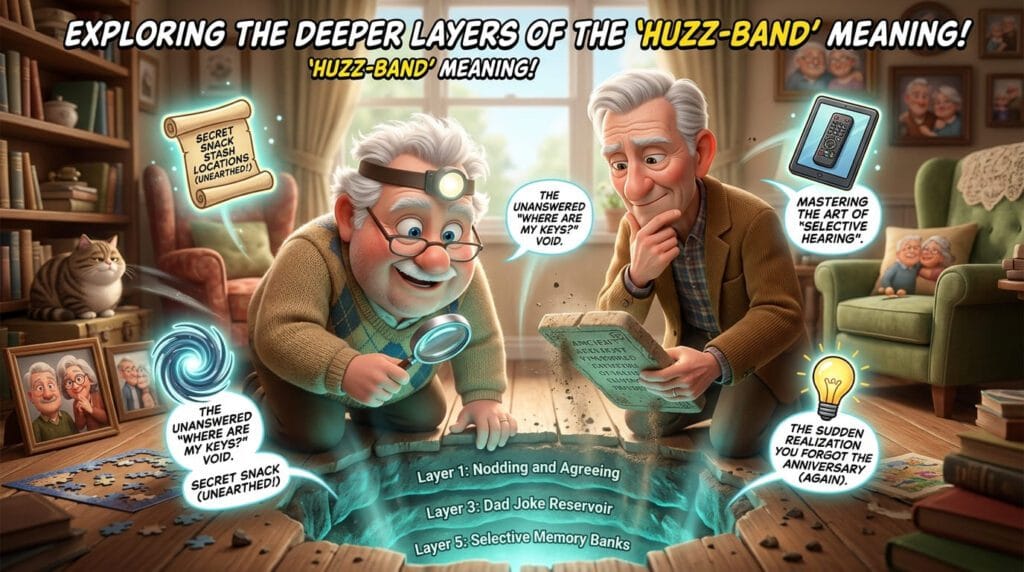
While the core huzz meaning revolves around excitement and celebration, the word has developed several nuanced shades depending on how and where it’s used. Language is flexible, and slang is especially flexible. So “huzz” doesn’t carry just one rigid definition it adapts to the situation.
Here are the different emotional layers people attach to the word:
1. Pure Celebration 🎉
This is the most straightforward use. Something good happened, and you’re expressing your happiness about it.
“We won the match! Huzz!”
2. Enthusiastic Agreement
Sometimes “huzz” functions as a way of saying “I’m totally on board with that” or “I love that idea.”
“Road trip this weekend?” — “Huzz, absolutely!”
3. Playful Sarcasm 🙃
In the right context, “huzz” can carry an ironic or sarcastic tone. It’s the kind of dry humor that thrives in online spaces.
“Another group project where I do all the work. Huzz.”
4. Friendly Energy
People also use “huzz” to set a warm, upbeat tone in conversations — almost like a verbal high-five.
“Morning everyone, huzz! Let’s make today count 💪”
5. Casual Filler with Personality
Sometimes it doesn’t carry deep meaning at all. It’s just a fun sound, a vibe word, something you throw into a sentence because it feels right.
“Huzz huzz, what’s going on y’all?”
The beauty of the huzz meaning is its adaptability. It bends to fit your mood, your audience, and your platform. That flexibility is exactly why it’s caught on so quickly.
Where Did “Huzz” Come From? Tracing Its Roots
Understanding the huzz meaning fully requires us to look backward — way backward. Because while “huzz” feels like a freshly minted internet term, its ancestry actually stretches back centuries.
The “Huzzah” Connection
Most language enthusiasts and etymologists agree that “huzz” is a shortened, modernized version of “huzzah” — a word that dates back to the late 1500s and was widely used through the 1700s.
“Huzzah” was a shout of triumph, joy, or encouragement. Soldiers yelled it after winning battles. Sailors bellowed it from ship decks. Common people cried it during festivals and celebrations. It was the “let’s go!” of its era.
Over the centuries, “huzzah” gradually faded from everyday speech. It became the kind of word you’d only hear in period films, historical novels, or theatrical performances. By the 20th century, it was considered archaic a relic of a louder, more dramatic time.
But language has a funny way of circling back.
The Digital Revival
Enter the internet. Enter meme culture. Enter a generation of young people who love digging up old words and giving them a fresh coat of paint.
Somewhere in the early 2020s, “huzz” started appearing in online spaces. It wasn’t a deliberate campaign or a single viral moment it was more of a gradual, organic emergence. People began using “huzz” in:
- Discord servers
- Reddit threads
- TikTok comments
- Twitter (now X) replies
- Gaming chats
- Instagram captions
The shortened “huzz” felt more natural for digital communication than the full “huzzah.” It was quicker to type, easier to remember, and had a punchier sound. It fit the rhythm of modern text-speak perfectly.
And so, “huzz” found its second life.
A Timeline of Evolution
| Era | Word | Meaning | Typical Context |
|---|---|---|---|
| 1500s–1700s | Huzzah | Shout of victory, triumph, or joy | Battlefields, celebrations, public gatherings |
| 1800s–1900s | Huzzah (declining) | Archaic cheer, rarely used | Literature, theater, formal toasts |
| 2000s–2010s | Huzzah (ironic) | Used playfully in niche online communities | Reddit, Tumblr, retro-themed content |
| 2020s–2025 | Huzz | Modern slang for excitement and good vibes | TikTok, gaming, chats, memes, everyday digital speech |
What’s remarkable here is how the huzz meaning maintains the emotional DNA of its ancestor while completely transforming the packaging. The feeling is the same — joy, triumph, energy. But the delivery is totally different casual, compact, and digitally native.
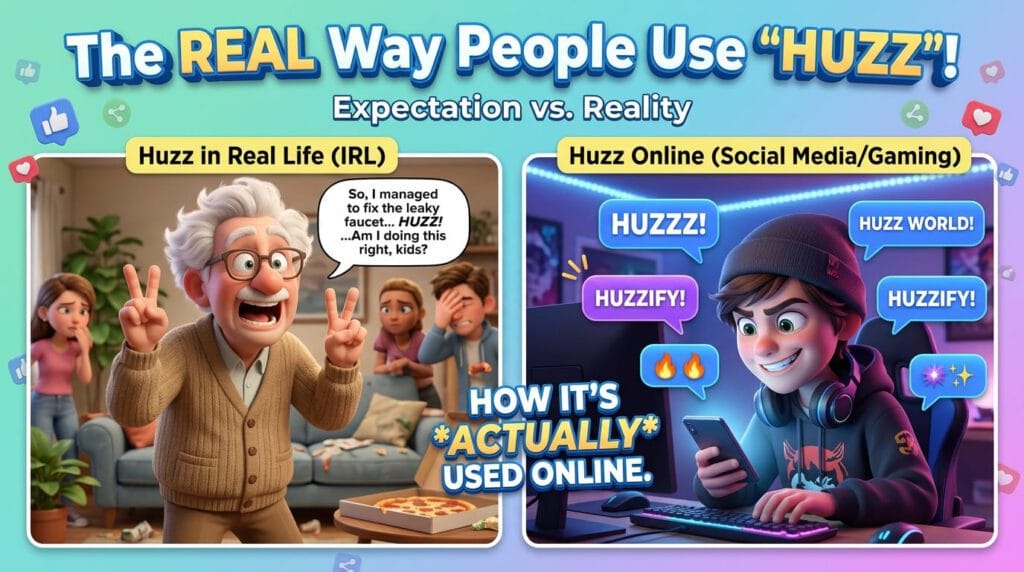
How People Actually Use “Huzz” in Real Life and Online
Theory is great, but let’s get practical. How does “huzz” show up in everyday digital communication? What does it look like in actual messages, posts, and comments?
Let’s walk through some realistic scenarios.
In Text Messages
Friend 1: “Bro, I just aced my driving test!”
Friend 2: “HUZZ! 🎉🎉 Let’s celebrate tonight!”Person A: “The pizza just arrived.”
Person B: “Huzz. That’s the best news I’ve heard all day 🍕”
In Social Media Captions
“First day at the new job. Nervous but excited. Huzz! 💼✨”
“Beach sunset with my people. Nothing but huzz vibes tonight 🌅”
In Comment Sections
User1: “Just dropped my new song, link in bio 🎶”
User2: “HUZZ this is fire!! 🔥🔥”User1: “We hit 10k followers!!”
User2: “Huzz! Y’all deserve it 🙌”
In Gaming Contexts
“Final boss defeated on the first try HUZZ!”
“Our team just clutched the last round. Huzz huzz huzz!”
In Memes and Humor
Picture of someone waking up and realizing it’s Saturday
Caption: “Huzz. 😌”Screenshot of a canceled Monday meeting
Caption: “The universe said huzz today.”
As you can see, the huzz meaning stays consistent across contexts — it’s always about positive energy but the specific flavor changes based on the situation. That’s what makes it so useful and so popular.
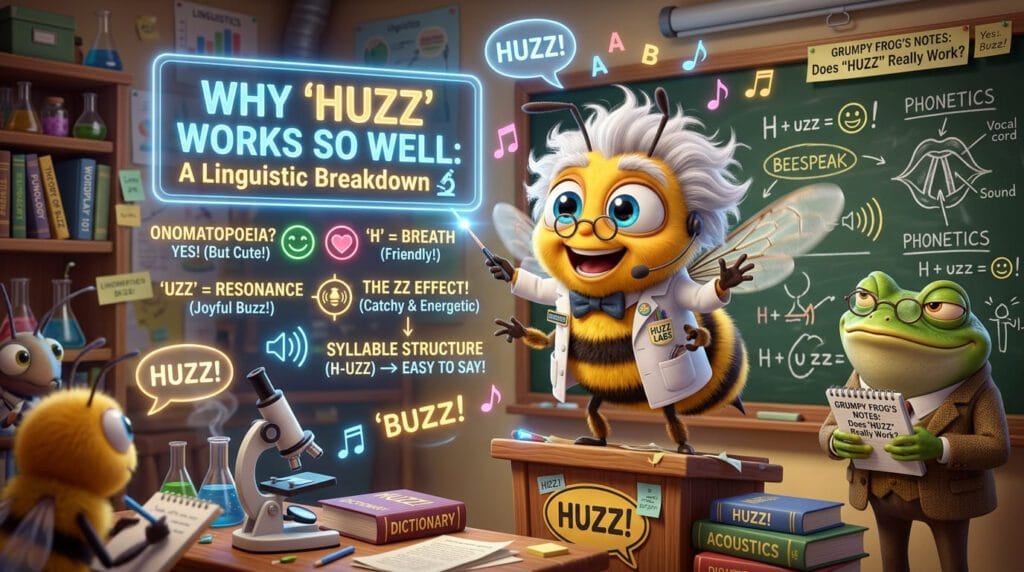
Why “Huzz” Works So Well: A Linguistic Breakdown
Not every slang word catches on. For every “huzz” that sticks, there are hundreds of attempted slang terms that never gain traction. So what makes “huzz” work from a linguistic perspective?
Let’s break it down.
1. Phonoaesthetic Appeal
“Huzz” just sounds satisfying. The breathy “h” opening, the warm “uh” vowel, and the buzzy “zz” ending create a sound that feels energetic and fun. Linguists call this phonoaesthetics the idea that certain sound combinations are inherently more pleasing or expressive than others.
Say “huzz” out loud right now. Feel how it buzzes in your mouth? That physical sensation reinforces the emotional meaning.
2. Brevity
In the age of rapid-fire texting and character limits, shorter is almost always better. “Huzz” is only four letters. It’s faster to type than “awesome,” more compact than “woohoo,” and less overused than “yay.”
3. Versatility
As we’ve already explored, “huzz” can be sincere, sarcastic, celebratory, or casual. A word that works across multiple emotional registers is far more likely to be adopted widely.
4. Novelty Factor
People like using words that feel fresh and slightly unexpected. “Huzz” stands out in a sea of “lol,” “omg,” and “fire” precisely because it’s different. It makes the user feel creative and in-the-know.
5. Community Identity
Using “huzz” signals that you’re part of certain online communities gaming circles, meme cultures, Gen Z and Gen Alpha digital spaces. Slang always serves a social bonding function, and “huzz” is no exception.
6. Emoji Compatibility
“Huzz” pairs beautifully with emojis. It’s the kind of word that invites visual reinforcement:
- Huzz 🔥
- Huzz 🎉
- Huzz 💯
- Huzz 🙌
- Huzz 😌
This makes it perfect for the highly visual communication style dominant on platforms like Instagram, TikTok, and Snapchat.
Huzz Meaning Across Different Online Communities
One of the most interesting things about the huzz meaning is how it subtly shifts depending on which corner of the internet you’re in. Let’s take a quick tour.
Gaming Community
In gaming spaces — Twitch streams, Discord servers, multiplayer chats “huzz” often signals victory, achievement, or clutch moments. It’s the word you type when your squad wins, when you pull off an impossible play, or when you finally beat a level that’s been driving you crazy.
“Ranked up to Diamond — HUZZ!”
Meme Culture
In meme circles, “huzz” is frequently used with ironic or exaggerated enthusiasm. The humor comes from applying big celebration energy to mundane, everyday situations.
Successfully parallel parked on the first try
“Huzz. I am unstoppable.”
Fandom Spaces
When a new trailer, episode, or album drops, fans across Twitter, Reddit, and TikTok use “huzz” to channel their collective excitement.
“New season confirmed?? HUZZ THIS IS NOT A DRILL”
Wellness and Positivity Communities
Some online spaces focused on mental health, motivation, and daily gratitude have adopted “huzz” as a gentle, uplifting expression. It’s softer in these contexts less about hype and more about appreciating small wins.
“Made it through a tough week. Huzz for surviving”
Friend Groups and Group Chats
In private group chats, “huzz” often serves as a bonding word — an inside joke or shared vocabulary that strengthens group identity.
“Movie night at my place!” — “HUZZ” — “HUZZ” — “HUZZ” (the whole group replies)
Each community puts its own fingerprint on the huzz meaning, and that’s exactly what keeps the word alive and evolving.
Words That Vibe Similarly to “Huzz”
If you enjoy the energy of “huzz,” there are several other slang words operating on a similar wavelength. Here’s a comparison to help you understand where “huzz” fits in the broader slang ecosystem:
| Word | Tone | Energy Level | Best Used For |
|---|---|---|---|
| Huzz | Playful, versatile | Medium to high | Celebration, agreement, humor |
| Yas | Enthusiastic, dramatic | High | Strong approval, excitement |
| Woohoo | Pure joy | High | Celebration, happy moments |
| Ayy | Cool, casual | Medium | Greetings, mild excitement |
| Let’s gooo | Hype, motivational | Very high | Pumping up energy, big moments |
| Vibe | Chill, positive | Low to medium | Describing good energy or mood |
| Sheesh | Impressed, surprised | Medium to high | Reacting to something impressive |
| Slay | Empowering, admiring | High | Complimenting someone’s achievement |
While all these words share positive emotional territory, “huzz” occupies a unique sweet spot. It’s not as intense as “yas” but not as laid-back as “vibe.” It’s energetic without being exhausting, enthusiastic without being over-the-top. That Goldilocks quality is part of its charm.
Is “Huzz” the Same as “Huzzah”? Let’s Settle This
This is a question that comes up frequently when people look into the huzz meaning. And the answer is: related, but not identical.
Think of it like this “huzzah” is the grandparent, and “huzz” is the grandchild. They share the same family tree, but they live in very different worlds.
| Aspect | Huzzah | Huzz |
|---|---|---|
| Era | 16th–18th century | 21st century |
| Tone | Formal, dramatic, theatrical | Casual, playful, digital |
| Length | Six letters, two syllables | Four letters, one syllable |
| Context | Historical speeches, battle cries, toasts | Texts, tweets, memes, captions |
| Emotional range | Triumph, honor, formal celebration | Excitement, humor, irony, everyday joy |
| Who uses it | Characters in period dramas | Gen Z, Gen Alpha, internet culture |
If you dropped “huzzah” into a group chat, people might chuckle it sounds deliberately old-fashioned, like you’re role-playing a medieval knight. But “huzz” fits seamlessly into modern conversation. It doesn’t need quotation marks or explanation. It just works.
So while the huzz meaning is historically connected to “huzzah,” the two words serve very different communicative purposes in today’s world.
The Psychology Behind Why We Love Saying “Huzz”
There’s actually some fascinating psychology at play when it comes to why certain slang words resonate with us. Understanding this helps us appreciate the huzz meaning on a deeper level.
Emotional Expression Made Easy
Humans have a constant need to express emotions but sometimes, standard language feels too formal, too slow, or too boring for the feeling we want to convey. Slang fills that gap. “Huzz” gives people a quick emotional release valve. One word, and the feeling is communicated.
The Dopamine of Novelty
Our brains are wired to enjoy novelty. When we discover a new word that feels fresh and fun, we get a tiny rush of pleasure. Using “huzz” feels like being in on something cool like you’re part of a trend before it goes mainstream.
Social Belonging
Language is one of the most powerful tools for group identity. When you use the same slang as your friends, your online community, or your generation, it reinforces your sense of belonging. “Huzz” says, “I’m part of this. I get it. I’m one of you.”
Playfulness and Humor
Life is stressful. Work is exhausting. The world can feel heavy. Words like “huzz” inject a moment of lightness and playfulness into daily communication. They remind us that language can be fun not just functional.
The Power of Sound
As we discussed earlier, the phonoaesthetic quality of “huzz” makes it physically satisfying to say and type. That buzzy “zz” ending creates a mini sensory experience. Our brains associate that satisfying sound with positive emotion, making us want to use the word again and again.
Can “Huzz” Be Used as a Name or Nickname?
Here’s a fun side note about the huzz meaning beyond being a slang exclamation, “huzz” has also found a second life as a nickname, username, and gamer tag.
And honestly? It makes perfect sense. “Huzz” is:
- Short and memorable
- Easy to spell
- Unique enough to stand out
- Cool-sounding without being tryhard
Popular Username Variations:
- HuzzKing
- TheHuzz
- HuzzVibes
- LilHuzz
- HuzzMaster99
- ItsMeHuzz
- HuzzGaming
You’ll find these kinds of names across platforms like:
- Twitch (gaming streamers)
- Discord (community servers)
- Roblox and Fortnite (player tags)
- Instagram (creative accounts)
- YouTube (content creators)
Some people even use “Huzz” as a real-life nickname among friends. If you’re the person in the group who’s always hyped up, always bringing the energy, always the first to celebrate getting tagged as “Huzz” feels pretty fitting.
So depending on the context, the huzz meaning can extend beyond slang into personal identity and branding.
How “Huzz” Reflects Bigger Trends in Language Evolution
Zoom out for a moment, and the rise of “huzz” tells us something important about how language works in the digital age.
Trend 1: Historical Recycling
Modern slang doesn’t always emerge from nothing. Sometimes it revives old words and gives them new meaning. “Huzz” from “huzzah” is a perfect example. Other cases include “slay” (originally a violent word, now meaning excellence) and “fire” (meaning something is amazing).
Trend 2: Compression
Digital communication favors shorter words. We’ve gone from “laughing out loud” to “lol” to “💀.” Similarly, “huzzah” compressed into “huzz.” The meaning stays; the syllables shrink.
Trend 3: Emotional Vocabulary Expansion
We’re developing a richer emotional vocabulary through slang. Instead of just “happy” or “excited,” we now have “huzz,” “slay,” “vibe,” “lit,” “bussin,” and dozens more each carrying a slightly different shade of positivity. This gives us more precise tools for emotional expression.
Trend 4: Community-Driven Language
Unlike previous eras where language change was driven by institutions (governments, academics, publishers), today’s linguistic evolution is driven by communities. A word catches on in a Discord server, spreads to TikTok, gets picked up by meme pages, and suddenly millions of people are using it. “Huzz” followed exactly this path.
Trend 5: Global Blending
The internet erases geographic boundaries for language. “Huzz” isn’t tied to any single country, dialect, or accent. It’s used by English speakers (and even some non-English speakers) around the world. This global reach accelerates adoption and solidifies the word’s place in the lexicon.
Common Mistakes People Make When Using “Huzz”
Even with a word as casual and flexible as “huzz,” there are a few missteps to watch out for. Here’s a quick guide to keeping your huzz usage smooth and natural.
Mistake 1: Overusing It
Dropping “huzz” once or twice in a conversation is fun. Dropping it in every single sentence becomes annoying. Let it breathe. Use it when it genuinely fits the moment.
Too much: “Huzz, woke up today. Huzz, had breakfast. Huzz, going to work. Huzz, it’s Tuesday.”
Just right: “Finally got that promotion I’ve been working toward. Huzz!”
Mistake 2: Using It in Formal Settings
“Huzz” is strictly casual territory. Don’t put it in a work email, a cover letter, an academic paper, or a professional presentation. Save it for texts, social media, and informal chats.
Nope: “Dear Hiring Manager, I am writing to express my interest in the position. Huzz.”
Yes: “Got the interview! Huzz, wish me luck 🤞”
Mistake 3: Forcing It When the Vibe Doesn’t Match
If the conversation is serious, emotional, or sensitive, throwing in a “huzz” can feel tone-deaf. Read the room (or the chat) before deploying it.
Best Practices:
- Pair it with emojis for maximum impact
- Use it at natural emotional peaks in conversation
- Let it come spontaneously rather than planning it
- Match its tone to the group you’re talking to
Huzz in Pop Culture and Media
While “huzz” hasn’t yet been featured in a Hollywood blockbuster or a chart-topping song (give it time), it has been making appearances in:
- TikTok videos with millions of views where creators use “huzz” as a celebratory catchphrase
- YouTube vlogs where influencers drop it casually during exciting moments
- Podcast conversations where hosts reference internet slang trends
- Twitch streams where chat rooms spam “HUZZ” during big gameplay moments
- Merchandise and apparel some independent creators have started making “Huzz” t-shirts, stickers, and hoodies
As the huzz meaning becomes more widely recognized, it’s likely we’ll see it appear in more mainstream media. It has all the ingredients of a word that could make the jump from niche internet slang to broadly understood cultural vocabulary.
Huzz Meaning: A Generational Perspective
Different generations relate to the huzz meaning in different ways:
Gen Z and Gen Alpha
These are the primary users and drivers of “huzz.” For them, it’s a natural part of their digital vocabulary as instinctive as “lol” or “bruh.” They use it freely, creatively, and without hesitation.
Millennials
Many millennials are familiar with “huzz” through exposure to younger siblings, coworkers, or social media feeds. Some adopt it enthusiastically; others observe from a distance with a mixture of curiosity and amusement.
Gen X and Boomers
These generations are less likely to encounter or use “huzz” organically, but when they do, they often connect it to “huzzah” — which they may recognize from historical contexts. Some find it charming; others find it confusing.
This generational gradient is completely normal. Every generation produces slang that feels foreign to those who came before. What’s interesting about “huzz” is its historical bridge it actually connects generations through its shared ancestral root in “huzzah,” even if the modern usage feels entirely different.
Expert Perspective on Slang Evolution
Linguists and cultural commentators have long studied how slang emerges, spreads, and either dies or gets absorbed into standard language. Here’s what the study of words like “huzz” reveals:
Slang is democratic. Unlike formal language changes that historically required institutional approval (dictionaries, style guides, government bodies), slang is created and popularized by everyday people. “Huzz” wasn’t introduced by a linguist or a marketing team. It bubbled up organically from digital communities.
Slang serves identity. Every slang word carries a social signal. Using “huzz” tells the listener something about who you are — your age, your online habits, your sense of humor, your vibe. It’s a linguistic badge of identity.
Slang is creative. The transformation from “huzzah” to “huzz” involves genuine linguistic creativity — compression, recontextualization, tonal shift, and community adoption. It’s not lazy language; it’s innovative language.
Slang is resilient. People have been predicting the death of “proper English” due to slang for centuries. Yet language continues to thrive, evolve, and express human experience in ever-richer ways. Words like “huzz” are evidence that language isn’t declining — it’s flourishing.
Will “Huzz” Last? Predicting Its Future
This is the million-dollar question whenever a new slang term rises to prominence. Will “huzz” still be around in five years? Ten years? Will it become a dictionary word, or will it fade like so many trendy expressions before it?
Arguments for longevity:
- Its historical root gives it depth and staying power
- Its versatility means it won’t get pigeonholed into one context
- Its phonoaesthetic appeal makes it inherently satisfying to use
- Its brevity makes it efficient for fast communication
- It’s already spreading across multiple platforms and communities
Arguments against longevity:
- Slang turnover is rapid new words constantly compete for attention
- It hasn’t yet achieved mainstream media saturation
- It could be displaced by the next viral exclamation
My honest take? “Huzz” has better staying power than most slang words. Its connection to “huzzah” gives it a cultural anchor that purely invented words lack. And its flexibility means it can continue adapting to new contexts rather than becoming stale.
Will it end up in the Oxford English Dictionary? Maybe not immediately. But five years from now, I wouldn’t be surprised to see it listed in slang databases, cultural glossaries, and informal dictionaries as a recognized expression of digital-age enthusiasm.
Tips for Naturally Incorporating “Huzz” Into Your Vocabulary
Want to start using “huzz” but not sure how to make it feel natural? Here are some practical suggestions:
- Start in low-stakes conversations. Drop it in a group chat with close friends before using it publicly.
- Pair it with context. Don’t just say “huzz” out of nowhere attach it to something worth celebrating.
- Match the platform. “Huzz” works best on Instagram, TikTok, Twitter/X, Discord, and texting. It might feel out of place on LinkedIn.
- Use emojis as amplifiers. “Huzz 🔥” hits different than plain “huzz.”
- Don’t explain it. Part of the fun of slang is using it confidently. If someone asks what it means, just explain casually that’s how language spreads.
- Let it evolve. Maybe you’ll develop your own variation “huzzin’,” “big huzz energy,” “huzz mode activated.” Creativity is encouraged.
Frequently Asked Questions About the Huzz Meaning
1. What is the huzz meaning in simple terms?
The huzz meaning is essentially an expression of excitement, joy, celebration, or positive energy. It’s a casual exclamation used primarily in digital communication — similar to saying “woohoo” or “let’s go.”
2. Is “huzz” a real word or just internet slang?
It’s internet slang that has become widely used in online communities. While it’s not currently in major dictionaries, it’s a legitimate part of modern informal language with roots in the historical word “huzzah.”
3. Where did the word “huzz” originate?
“Huzz” is derived from “huzzah,” a centuries-old exclamation of triumph and joy. The shorter form emerged in digital spaces during the 2020s as internet users adapted the classic word for modern communication.
4. Can I use “huzz” in professional or academic writing?
No. The huzz meaning is tied to casual, informal contexts. It’s best suited for texts, social media, gaming, and personal conversations. Keep it out of emails to your boss or research papers.
5. Is “huzz” only used by Gen Z?
While Gen Z and Gen Alpha are the primary users, “huzz” is spreading across age groups. Anyone who participates in online culture may encounter and adopt the word.
6. Does “huzz” have any negative connotations?
Not inherently. The huzz meaning is overwhelmingly positive. However, like any word, it can be used sarcastically or ironically — but even in those cases, the tone is usually playful rather than negative.
7. Is “huzz” the same as “huzzah”?
They’re related but not identical. “Huzzah” is the historical ancestor formal, dramatic, and archaic. “Huzz” is the modern descendant — casual, concise, and digital-native. They share emotional DNA but serve different communicative purposes.
8. Will “huzz” be added to the dictionary?
It’s possible. Many slang words eventually earn dictionary entries if they achieve sustained, widespread usage. “Huzz” is on a trajectory that could lead to formal recognition, though it’s too early to say definitively.
9. Can “huzz” be used as a name or nickname?
Absolutely. Many people use “Huzz” as a gamer tag, social media handle, or personal nickname. It’s short, memorable, and carries a positive connotation.
10. What’s the best way to use “huzz” in a sentence?
Use it naturally at moments of excitement or celebration. Examples: “Huzz, we made it!” or “Got the tickets huzz!” The key is to let it feel spontaneous rather than forced.
Final Thoughts: The Lasting Charm of the Huzz Meaning
We’ve taken a thorough journey through the huzz meaning from its historical roots in “huzzah” to its modern rebirth as a digital-age exclamation of joy, energy, and connection.
Here’s what we’ve learned:
✅ “Huzz” means excitement, celebration, and positive vibes
✅ It descends from the centuries-old cheer “huzzah”
✅ It thrives in texts, social media, gaming, and meme culture
✅ It’s versatile working for sincere joy, playful humor, and gentle sarcasm
✅ It’s linguistically satisfying short, punchy, and phonoaesthetically pleasing
✅ It reflects bigger trends in language evolutioncompression, recycling, community-driven change
✅ It doubles as a cool nickname or username
✅ It’s here to stay — at least for the foreseeable future
Language is one of the most human things about us. It’s how we share our inner worlds with each other. And slang messy, creative, ever-changing slang is language at its most alive.
“Huzz” captures something essential about how we communicate in 2025: quickly, joyfully, and with personality. It’s not just a word. It’s a feeling. It’s a tiny celebration packed into four letters. It’s a digital cheer that crosses communities, platforms, and even generations.
So the next time something great happens big or small go ahead and let it out.
Huzz!
You’ve earned it.