
You’re scrolling through your phone. Maybe you’re deep inside a TikTok comment section. Maybe you’re reading through a group chat that’s blowing up with notifications.
And then someone drops it.
“What’s the tea?”
You pause. You read it again. You wonder are these people actually discussing beverages right now?
No. They’re definitely not.
If you’ve stumbled across this phrase and felt slightly lost, you’re not alone. Thousands of people every single day type “what’s the tea slang meaning 2026” into their search bars because language moves fast, and nobody wants to feel left behind.
Here’s the good news. By the time you finish reading this article, you’ll understand exactly what this expression means, where it actually originated, why it refuses to die out, how people are using it right now in 2026, and how you can confidently use it yourself without sounding awkward.
Let’s get into it.
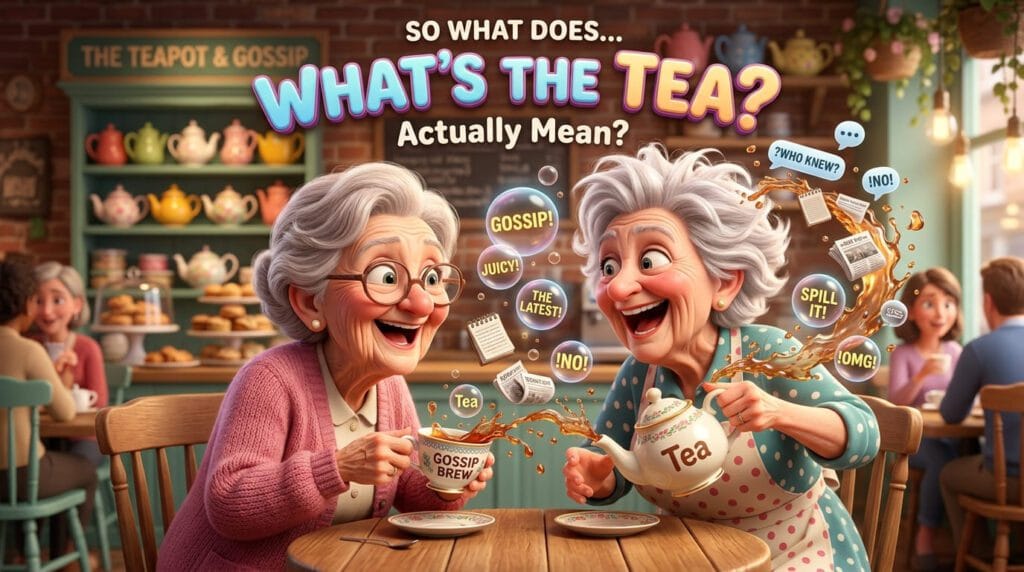
So What Does “What’s the Tea” Actually Mean?
Let’s start with the straightforward answer because you deserve clarity before we dive deeper.
When someone asks “what’s the tea,” they’re asking for gossip. They want the inside scoop. They’re requesting the juicy, behind-the-scenes, probably-shouldn’t-be-shared details about a person, situation, or event.
Think of it this way. Imagine your best friend walks into the room looking absolutely stunned. Their eyes are wide. They sit down slowly. You can tell something happened.
What do you say?
“Okay… what’s the tea?”
That’s the energy behind this phrase. It’s an invitation. It’s saying: I know something happened, and I want every single detail.
The Core Meaning Broken Down
- Tea = gossip, truth, revealing information, drama, secrets
- What’s the tea = what’s the gossip, what happened, tell me everything
- Spill the tea = share the gossip, reveal the secrets, don’t hold back
It sounds simple because it is simple. But the cultural weight behind this tiny three-letter word runs much deeper than most people realize.
Where Did This Expression Actually Come From?
Here’s where things get genuinely interesting.
Most people assume “tea” as slang was born on TikTok or Twitter sometime around 2018 or 2019. That assumption is completely wrong.
The roots of this expression stretch back decades, and understanding that history gives the phrase much richer meaning.
The Letter “T” and Its Original Purpose
Long before social media existed, long before smartphones, long before any of us were doom-scrolling at two in the morning, the word “T” was being used inside Black drag culture and LGBTQ+ communities as shorthand for truth.
When someone said “let me give you the T,” they meant “let me tell you the truth.” It was direct. It was bold. It was unapologetic.
This usage appeared in ballroom scenes, underground clubs, and tight-knit community gatherings where people spoke freely about their lives, their struggles, and yes, their drama.
The Literary Connection
In 1994, a writer named Lady Chablis a prominent drag performer used the phrase in the book Midnight in the Garden of Good and Evil by John Berendt. Lady Chablis talked about “the T” meaning truth and personal information.
This was one of the earliest mainstream appearances of the term in published form.
From “T” to “Tea”
Over time, the spelling and pronunciation naturally shifted. “T” became “tea.” The meaning expanded slightly. Instead of strictly meaning “truth,” it began encompassing gossip, rumors, drama, shocking revelations, and anything that made people lean forward in their seats.
The homophone connection between the letter T and the beverage tea made the wordplay irresistible. People started building entire metaphors around it:
- Spilling tea
- Sipping tea
- Pouring tea
- Serving tea
Each variation carried its own shade of meaning, and the internet ran with every single one.
Social Media Explosion
By the mid-2010s, tea slang had officially crossed over into mainstream internet language. Several key moments accelerated this:
- Reality television — shows featuring dramatic confrontations normalized phrases like “spill the tea” in front of millions of viewers
- Celebrity interviews — talk show hosts and entertainers began casually using the phrase
- Meme culture — the famous Kermit the Frog sipping tea meme (“but that’s none of my business”) cemented the visual connection between tea and gossip
- YouTube and TikTok — content creators built entire channels around “tea” content, discussing celebrity drama and internet controversies
By 2026, this expression isn’t just surviving. It’s thriving. It has become embedded in how an entire generation communicates.
How People Are Using “What’s the Tea” in 2026
Language doesn’t stay frozen. It breathes. It adapts. It shapeshifts based on who’s using it and where they’re using it.
In 2026, “what’s the tea” appears in contexts that would have surprised people even five years ago. Let’s look at how this phrase shows up across different settings.
On Social Media Platforms
Social media remains the natural habitat for this expression. You’ll find it everywhere.
TikTok comment sections:
“Wait this story has layers… what’s the tea though?”
“Someone in the comments please spill the tea because I’m confused.”
“The tea is SCALDING today.”
Instagram stories and captions:
“Posted a cryptic story and now everyone’s asking what’s the tea 😂”
“This weekend gave me enough tea to last a month.”
Twitter/X threads:
“Industry people are being very quiet right now… what’s the tea?”
“I woke up to trending topics and I need someone to explain the tea immediately.”
In Private Text Conversations
This is where tea slang feels most natural. Between close friends, in group chats, in those late-night messaging marathons where secrets flow freely.
Example conversation:
Person A: You’ll never guess what I found out today.
Person B: Don’t do this to me. What’s the tea??
Person A: So apparently the whole situation was way more complicated than anyone thought.
Person B: I’m sitting down. I’m ready. Pour.
Another example:
Person A: Did you see what happened after we left?
Person B: NO. What’s the tea? I knew something was off.
Person A: Okay so basically…
Notice the rhythm. There’s anticipation. There’s excitement. There’s that delicious moment right before the story drops where everyone leans in.
That’s the magic of this phrase. It turns ordinary storytelling into an event.
Among Friend Groups and Social Circles
In real life — yes, people still talk face to face in 2026 — the phrase has become completely normalized among younger demographics.
You’ll hear it in college cafeterias, at brunches, during work breaks, at family gatherings (among the younger cousins, at least).
“Okay the kids left the room. What’s the tea with your neighbor situation?”
“I’ve been holding onto this tea all week and I physically cannot keep it inside anymore.”
“No tea today honestly. My life has been boring.”
In Professional Spaces (Carefully)
Here’s where things get nuanced.
In formal professional settings — board meetings, client presentations, official emails — tea slang has no place. Using it would sound jarring and unprofessional.
However, in casual workplace conversations among colleagues who share a friendly relationship, it absolutely appears.
“What’s the tea with the restructuring? I heard some things.”
“HR had a closed-door meeting for two hours. Someone needs to spill.”
The key distinction is audience awareness. People in 2026 generally understand when slang is appropriate and when it isn’t. Context determines everything.
Every Variation of Tea Slang You Should Know
The beauty of this expression lies in its flexibility. “What’s the tea” is just one version. The slang universe has expanded this concept into an entire vocabulary.
Spill the Tea
Meaning: Share the gossip. Tell the story. Don’t hold back.
This is arguably the most popular variation. When someone says “spill the tea,” they’re done waiting. They want the information right now.
“You’ve been hinting at drama all day. Just spill the tea already.”
Sipping Tea
Meaning: Observing drama without getting involved. Watching things unfold from a safe distance.
This one carries a different energy. It’s passive. It’s detached. It says “I see what’s happening but I’m choosing to stay out of it.”
“I’m just sipping my tea and watching this situation implode on its own.”
The Kermit meme energy lives here permanently.
Hot Tea
Meaning: Fresh gossip. Brand new information. Something that just happened or was just discovered.
Temperature matters in this metaphor. Hot tea means the gossip is current, urgent, and possibly still developing.
“I have HOT tea about what went down last night.”
Cold Tea
Meaning: Old gossip. Information that everyone already knows. Yesterday’s news.
Nobody gets excited about cold tea. If someone shares drama that happened three weeks ago and everyone’s already discussed it, that’s cold tea.
“You’re just now hearing about that? That’s cold tea at this point.”
Sweet Tea
Meaning: Positive gossip. Happy news. Updates that make people smile rather than gasp.
Not all tea involves scandal. Sometimes the gossip is actually wonderful.
“I have sweet tea — she got the promotion and didn’t tell anyone yet!”
Messy Tea
Meaning: Complicated, chaotic, multi-layered drama. The kind of gossip that requires a full timeline and possibly a chart.
“The situation between those three is messy tea. I don’t even know where to start.”
Piping Hot Tea
Meaning: Extremely fresh and shocking gossip. Even more urgent than hot tea.
“This is piping hot tea. Like, I literally just found out thirty seconds ago.”
No Tea, No Shade
Meaning: Saying something honest without intending disrespect. Being truthful without malicious intent.
This variation acknowledges that truth can sometimes sting, but the speaker isn’t trying to be hurtful.
“No tea, no shade, but that presentation needed more preparation.”
Tea Time
Meaning: A designated moment for sharing gossip. Often used humorously to signal that the storytelling is about to begin.
“Everyone sit down. It’s tea time.”
Serving Tea
Meaning: Delivering gossip with confidence and flair. Being the primary source of information.
“She walked in and served tea about the entire situation without hesitating.”
The Psychology Behind Why People Love This Expression
Let’s pause from definitions for a moment and talk about something deeper.
Why does this phrase resonate so powerfully? Why has it survived years of internet trend cycles while countless other slang terms faded into obscurity?
The answer connects to fundamental aspects of human behavior.
Curiosity Is Hardwired
Humans are inherently curious creatures. We crave information. We want to understand what’s happening around us, especially when it involves other people’s lives, relationships, and conflicts.
When someone says “I have tea,” it triggers an immediate curiosity response. Your brain wants that information. The anticipation alone creates a small dopamine spike.
The phrase essentially packages gossip as a gift waiting to be unwrapped.
Social Bonding Through Shared Stories
Anthropologists have long observed that storytelling and information-sharing serve as social glue. When friends exchange gossip, they’re not just talking — they’re reinforcing trust, building intimacy, and creating shared experiences.
“What’s the tea” functions as an invitation into that bonding ritual. It says: I trust you enough to ask, and I want you to trust me enough to share.
The Playfulness Factor
Serious conversations about other people’s lives can feel uncomfortable. They can feel invasive or judgmental.
Tea slang softens that discomfort through humor and playfulness. Framing gossip as “tea” makes it feel lighter, more entertaining, less morally weighted.
It gives people permission to engage with drama without feeling guilty about it.
Identity and Belonging
Using current slang signals group membership. When someone uses “what’s the tea” correctly and naturally, they’re demonstrating cultural awareness. They’re showing that they belong to a particular social community.
In 2026, this expression bridges age gaps, cultural backgrounds, and geographic boundaries. It’s become a universal marker of internet-era communication.
How “What’s the Tea” Functions Differently Across Cultures in 2026
One of the most fascinating aspects of this phrase’s evolution is how it has been adopted and adapted across different cultural contexts worldwide.
Western English-Speaking Countries
In the United States, United Kingdom, Canada, and Australia, tea slang is fully mainstream. People of all ages recognize it, even if older generations don’t use it themselves.
It appears in advertising campaigns, television dialogue, podcast titles, and everyday conversation without requiring explanation.
South and Southeast Asian Online Communities
Young internet users across Asia have embraced tea slang enthusiastically, particularly within fan communities discussing K-pop, Bollywood, and other entertainment industries.
The phrase often appears in English even within conversations primarily conducted in other languages, functioning as a borrowed expression.
Middle Eastern Digital Spaces
In online communities throughout the Middle East, tea slang shows up in influencer content, celebrity discussion forums, and social media interactions.
The irony isn’t lost on anyone — in cultures where actual tea holds deep social significance, the metaphorical use of “tea” for gossip carries an additional layer of humor.
African Digital Communities
Across African countries with strong internet cultures — Nigeria, Kenya, South Africa, and others — tea slang has been woven into already rich traditions of expressive, colorful communication.
It often appears alongside local slang, creating unique hybrid expressions.
The Universal Thread
Regardless of geography, the underlying concept remains identical: people everywhere want to share stories, discover secrets, and bond through shared information.
“What’s the tea” simply gives that universal impulse a catchy, memorable name.
Common Misconceptions About Tea Slang
Despite its widespread use, several misunderstandings persist around this expression. Let’s clear them up.
Misconception 1: Tea Always Means Lies or Rumors
Wrong. While tea can sometimes involve unverified information, the original meaning connects to truth. When someone spills the tea, they’re often sharing what they believe to be genuine information.
The accuracy of that information varies, obviously. But the intent behind “tea” is revelation, not fabrication.
Misconception 2: Only Young People Use This Phrase
Increasingly untrue. While younger demographics pioneered the mainstream adoption, people in their 30s, 40s, and beyond now use it comfortably — especially those active on social media.
In 2026, age-based assumptions about slang usage are becoming less reliable.
Misconception 3: It’s Disrespectful or Mean-Spirited
Context determines everything. Sharing tea about a friend’s surprise engagement is joyful. Spreading harmful information about someone’s private struggles is cruel.
The phrase itself is neutral. The speaker’s intent and the content being shared determine whether it’s positive, harmless, or problematic.
Misconception 4: Tea Slang Is Fading Out
Some language commentators predicted that tea slang would fade by the mid-2020s. That prediction was wrong. The phrase has demonstrated remarkable staying power precisely because it fills a genuine communicative need.
People will always gossip. And as long as they gossip, they’ll need fun, expressive ways to talk about gossip.
Misconception 5: It Was Invented on Social Media
As we discussed in the origin section, this expression predates social media by decades. Platforms like TikTok and Twitter amplified it, but they didn’t create it. Credit belongs to the Black drag and LGBTQ+ communities who gave birth to this language.
How to Use “What’s the Tea” Without Sounding Forced
This is the section many people secretly need.
You understand the meaning. You know the history. But you’re worried about actually using it in conversation because nothing feels worse than using slang incorrectly.
Here are honest, practical guidelines.
Read the Room First
Before dropping “what’s the tea” into any conversation, assess whether the setting supports casual language. Close friends? Absolutely. Business presentation? Absolutely not.
Let It Flow Naturally
The worst thing you can do is force slang into a sentence where it doesn’t belong. If the phrase doesn’t feel natural coming out of your mouth, don’t use it. There’s nothing wrong with saying “what happened?” instead.
Match the Energy of the Conversation
If someone is sharing something lighthearted and dramatic, “what’s the tea” fits perfectly. If someone is sharing something genuinely painful or serious, the phrase might feel dismissive.
Don’t Overuse It
Using “tea” in every other sentence dilutes its impact and starts sounding performative. Sprinkle, don’t pour.
Acknowledge Its Origins
If someone asks where the phrase comes from, give credit where it’s due. Acknowledging the Black and LGBTQ+ roots of this expression shows respect and cultural awareness.
A Helpful Comparison: Tea vs. Similar Expressions
Understanding how “tea” relates to other words helps clarify its unique position.
| Expression | Meaning | Emotional Tone | Typical Setting |
|---|---|---|---|
| Tea | Gossip, truth, inside info | Playful, excited | Casual, social media |
| Gossip | Talking about others’ lives | Neutral to negative | Everyday conversation |
| Rumor | Unconfirmed claim | Suspicious, uncertain | Various settings |
| Scoop | Exclusive information | Journalistic, eager | Media, casual |
| Drama | Conflict or tension | Intense, emotional | Social situations |
| News | Verified information | Formal, objective | Professional, media |
| Dirt | Negative information | Sneaky, exposing | Informal conversations |
| Intel | Inside knowledge | Strategic, secretive | Various settings |
The key difference? Tea carries warmth and playfulness that most of these alternatives lack. It transforms information-sharing from a neutral act into an entertaining social ritual.
What Does the Future Hold for Tea Slang?
Predicting slang longevity is notoriously difficult. Language experts have been wrong countless times. But certain indicators suggest tea slang has genuine staying power.
Deep Cultural Roots
Expressions with shallow origins — those invented purely as internet jokes tend to burn bright and die fast. Tea slang has decades of cultural history supporting it. That foundation provides durability.
Functional Usefulness
Tea slang fills a real gap in conversational English. Before this expression became mainstream, there wasn’t a widely recognized, single-word term that simultaneously conveyed gossip, excitement, and intimacy. “Tea” does all three.
Continuous Evolution
The phrase keeps generating new variations. As long as speakers continue creating fresh expressions within the “tea” framework — hot tea, cold tea, messy tea, sweet tea the core concept stays vibrant and relevant.
Cross-Platform Adaptability
Unlike slang that only works on specific platforms, tea slang translates seamlessly across TikTok, Instagram, Twitter, real-life conversations, text messages, and more. This cross-platform flexibility extends its lifespan significantly.
My Honest Prediction
Tea slang isn’t going anywhere in 2026 or beyond. It may evolve. New variations may emerge while older ones fade. But the core concept using “tea” to describe gossip and truth has become a permanent fixture in modern English communication.
Frequently Asked Questions
What does “what’s the tea” mean in slang?
It means “what’s the gossip” or “what’s the interesting information.” When someone asks “what’s the tea,” they want to hear the inside story, drama, or hidden details about a situation.
Is “what’s the tea” still popular in 2026?
Absolutely. The phrase remains widely used across social media platforms, text conversations, and real-life interactions. Its popularity has shown no signs of declining.
Where did “tea” slang originally come from?
The expression originated in Black drag culture and LGBTQ+ communities, where “T” stood for “truth.” Over time, “T” evolved into “tea” and expanded to encompass gossip and inside information more broadly.
Is saying “what’s the tea” considered rude?
Not inherently. The phrase is playful and casual. However, context matters. Using it in formal settings might seem inappropriate, and the content being discussed determines whether the conversation itself is respectful or harmful.
What’s the difference between “spill the tea” and “what’s the tea”?
“What’s the tea” is a question asking for information. “Spill the tea” is a command encouraging someone to share information they already have. Both revolve around the same concept but serve different conversational purposes.
Can I use “what’s the tea” in professional settings?
Only in very casual, informal workplace conversations with colleagues you know well. It should never appear in formal emails, presentations, or meetings.
Does “tea” always refer to negative gossip?
No. While tea often involves drama or controversy, it can also refer to positive news, funny stories, or neutral updates. “Sweet tea” specifically describes happy or positive gossip.
Why do people say “sipping tea” instead of “spilling tea”?
“Sipping tea” means observing drama without participating. It signals that someone is watching a situation unfold while choosing to stay uninvolved. “Spilling tea” means actively sharing the information.
Is tea slang only used in English?
While it originated in English, the expression has been adopted by internet users worldwide. People across various countries and languages use it, particularly in online spaces.
Final Thoughts
Language tells us who we are and how we connect with each other.
“What’s the tea” isn’t just a slang phrase. It’s a cultural artifact. It carries the history of marginalized communities who created expressive, vibrant language long before the mainstream world paid attention. It reflects our fundamental human desire to share stories, bond through conversation, and make everyday communication more colorful.
In 2026, understanding this phrase means more than knowing a definition. It means understanding how modern communication works — how playfulness and curiosity drive the words we choose, how internet culture accelerates linguistic evolution, and how a single metaphor can unite millions of people across backgrounds and borders.
So the next time someone looks at you and asks, “what’s the tea?” — you’ll know exactly what they mean.
And more importantly, you’ll know exactly how to respond.