
Food meaning slang has completely transformed how we talk to each other. Walk into any room full of teenagers, open any social media app, or listen closely to the conversations happening around you at a coffee shop and you’ll notice something fascinating. People aren’t just talking about what they had for dinner. They’re using food vocabulary to describe emotions, people, drama, money, conflicts, and so much more.
When your friend says someone has “beef” with another person, nobody’s thinking about a steakhouse. When someone whispers “spill the tea,” they’re definitely not asking about your favorite chai blend. And if you get called “a whole meal,” trust me, it has absolutely nothing to do with your cooking skills.
Food meaning slang has woven itself so deeply into our daily conversations that most people don’t even realize they’re doing it. But where did all this come from? Why food, of all things? And how do you use these expressions without sounding like you’re trying way too hard?
I’m going to walk you through everything. Every term, every nuance, every awkward mistake I personally made along the way. By the end, you won’t just understand food slang you’ll feel it.
Quick Overview Table
| Slang Expression | What It Actually Means | How You’d Hear It Used |
|---|---|---|
| Snack | Someone who looks really attractive | “Did you see her today? Total snack.” |
| Whole Meal | Even more attractive than a snack | “Forget snack — that man is a whole meal.” |
| Bread | Money, earnings, financial gains | “Can’t hang out tonight, I’m chasing bread.” |
| Tea | Gossip, insider information, drama | “Wait, what happened? Spill the tea!” |
| Sauce | Swagger, confidence, unique style | “He walked in with so much sauce.” |
| Salty | Feeling bitter, annoyed, or upset | “She’s been salty ever since she lost.” |
| Spicy | Bold, provocative, controversial | “That tweet was incredibly spicy.” |
| Cheesy | Overly sentimental, corny, cliché | “That pickup line was painfully cheesy.” |
| Juicy | Exciting, scandalous, gossip-worthy | “Tell me everything — this sounds juicy.” |
| Cooked | Finished, done for, in deep trouble | “After that exam, I’m absolutely cooked.” |
| Beef | A conflict, disagreement, or feud | “Those two have had beef for months.” |
| Thirsty | Desperately seeking attention or validation | “He liked all 47 of her photos. So thirsty.” |
| Extra | Dramatically over the top | “You brought a fog machine to a picnic? You’re so extra.” |
| Burnt | Embarrassed or roasted badly | “That comeback left him completely burnt.” |
| Raw | Unfiltered, authentic, emotionally honest | “That poem she read was absolutely raw.” |
| Half-baked | Poorly thought out, incomplete | “Your business plan sounds half-baked honestly.” |
| Simmering | Quietly angry, holding back frustration | “She didn’t say anything but she was simmering.” |
How I Accidentally Discovered Food Meaning Slang
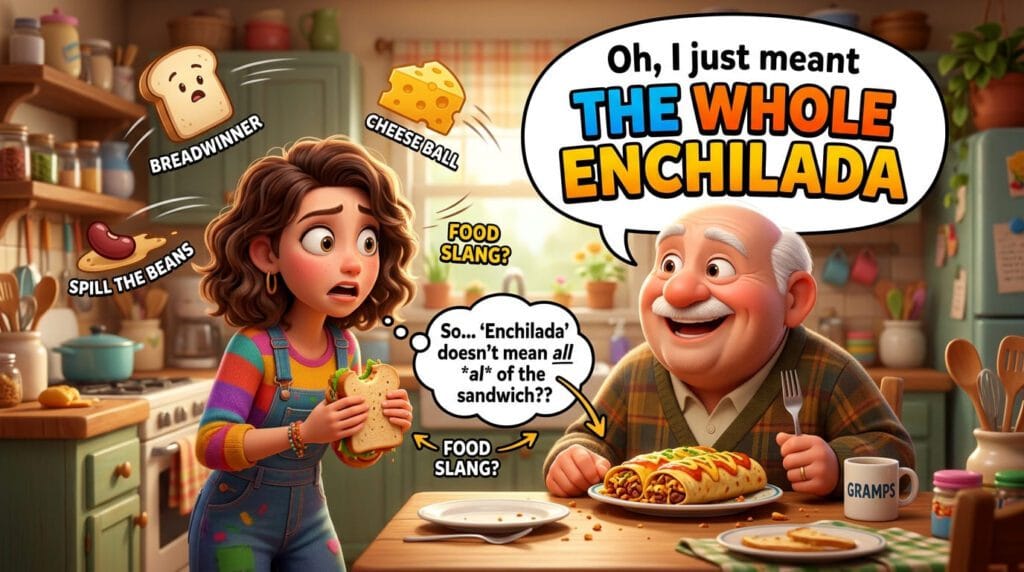
Let me take you back to a very specific Tuesday evening. I remember it clearly because I was eating leftover biryani actual food while scrolling through my Instagram reels. My younger brother, who is fifteen and lives approximately ninety percent of his life on the internet, walked past my screen, glanced at a reel I was watching of someone solving a complex math problem in an incredibly elegant way, and said:
“That’s food, bhai.”
I looked at my biryani. I looked at the screen. I looked back at him.
“What’s food?” I asked, completely serious.
He stared at me like I had just asked what the sky was. Then he laughed for about forty-five seconds straight, which felt significantly longer when you’re the one being laughed at.
That interaction — that single, slightly humiliating moment sparked a curiosity in me that I genuinely didn’t expect. I started paying attention. I started noticing how often food words appeared in conversations that had absolutely nothing to do with eating. And the deeper I looked, the more fascinating it became.
Food meaning slang isn’t just a handful of quirky expressions. It’s an entire linguistic ecosystem that reveals how creative, adaptive, and culturally connected human communication really is.
And honestly? Once you start noticing it, you can’t stop.
What Exactly Is Food Meaning Slang?
Let’s establish this properly, because it’s more layered than most people realize.
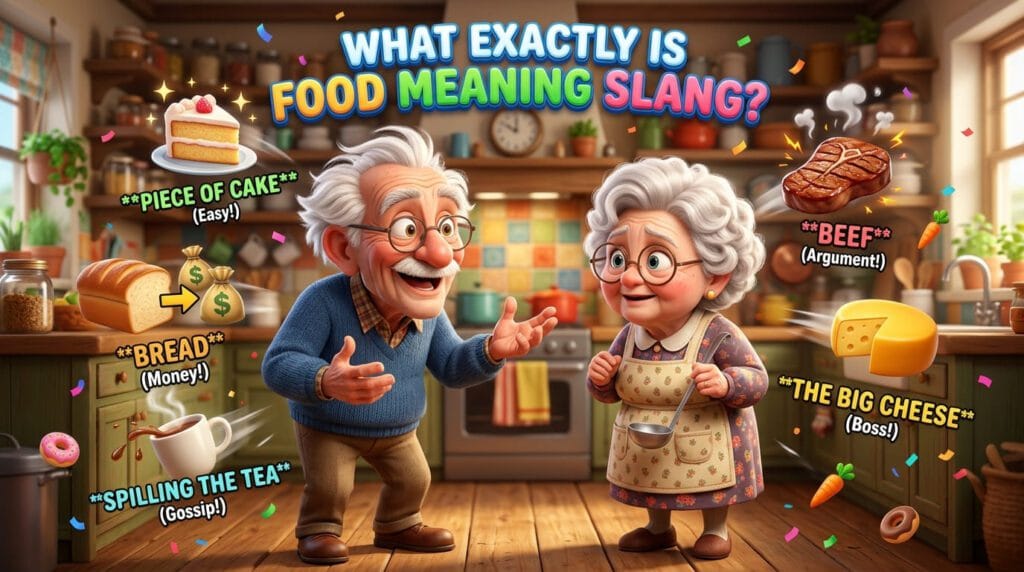
Food meaning slang refers to the widespread practice of taking words that originally belong to the world of cooking, eating, and cuisine and repurposing them to express emotions, describe people, comment on situations, or communicate ideas that have zero connection to actual food.
This isn’t new. Humans have been doing this for centuries in some form. But what’s happened in recent years particularly since the explosion of social media platforms, short-form video content, and global internet culture is that this process has accelerated dramatically. New food-based slang terms are being coined, adopted, spread, and sometimes retired within months.
The reason food works so well as a source for slang is something I find genuinely beautiful: everyone eats. Food is universal. Every single person on this planet, regardless of language, culture, age, or background, has a deep relationship with food. We all know what it feels like to taste something incredible. We all understand the difference between bland and flavorful, between raw and cooked, between sweet and salty.
So when someone borrows those sensations and applies them to non-food contexts, the meaning transfers almost instantly. You don’t need a dictionary. You don’t need an explanation. Your body already understands what “spicy” feels like so when someone describes a controversial opinion as “spicy,” you immediately grasp the intensity, the heat, the slight danger of it.
That’s the magic of food meaning slang. It communicates through sensation and shared experience rather than through technical definition.
The Deep Roots Behind Food Slang
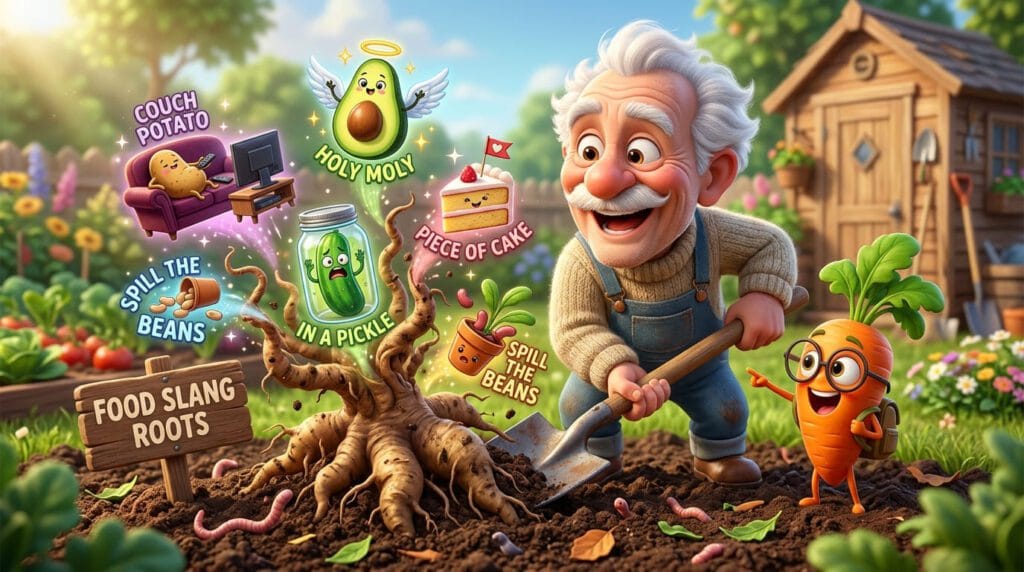
If you think food slang started with TikTok, I need to gently correct that assumption. The roots run much, much deeper.
African American Vernacular English (AAVE)
A huge portion of the food slang we use today originated within Black American communities, particularly through African American Vernacular English. This linguistic tradition has always been extraordinarily creative and influential — consistently generating new expressions, metaphors, and verbal innovations that eventually spread into mainstream culture.
Terms like “beef” (meaning conflict), “salty” (meaning bitter or upset), and “tea” (meaning gossip) all have strong roots in AAVE and Black cultural spaces. These weren’t invented by social media algorithms. They were created by real people in real communities, often decades before the internet amplified them.
It’s important to acknowledge this origin because too often, slang gets divorced from its cultural context once it goes mainstream. People use the words without understanding or crediting where they came from. And that erasure matters.
Hip-Hop and Music Culture
Hip-hop has been one of the most powerful vehicles for spreading food slang into wider consciousness. Rappers and lyricists have long used food metaphors to talk about wealth (“bread,” “dough,” “cheddar”), conflict (“beef”), and quality (“that track is food for the soul”).
Music moves fast, travels far, and reaches people across every demographic. When a popular song uses a food term in a new way, millions of listeners absorb it almost unconsciously. Within weeks, that expression enters everyday conversation.
Internet Culture and Meme Communities
The internet didn’t create food slang, but it poured rocket fuel on it. Platforms like Twitter, Vine (remember Vine?), Instagram, and later TikTok created environments where clever language could go viral overnight.
A single tweet using a food word in a funny or relatable way could rack up hundreds of thousands of interactions, embedding that usage into the collective vocabulary of an entire generation. Meme culture especially loves food slang because it’s visual, punchy, and immediately understandable perfect for the fast-scroll nature of social media.
Everyday Human Psychology
Beyond cultural and technological factors, there’s a simple psychological reason food slang works so well: our brains process food-related language differently than abstract vocabulary.
When you read the word “sweet,” your brain doesn’t just register a definition. It activates sensory memories — the taste of sugar, the feeling of enjoying something pleasant. This sensory activation makes food-based slang feel more vivid, more immediate, and more emotionally resonant than clinical language.
That’s why saying “the situation is spicy” feels so much more alive than saying “the situation is controversial.” Same meaning, completely different impact.
Every Major Food Slang Term Explained in Detail
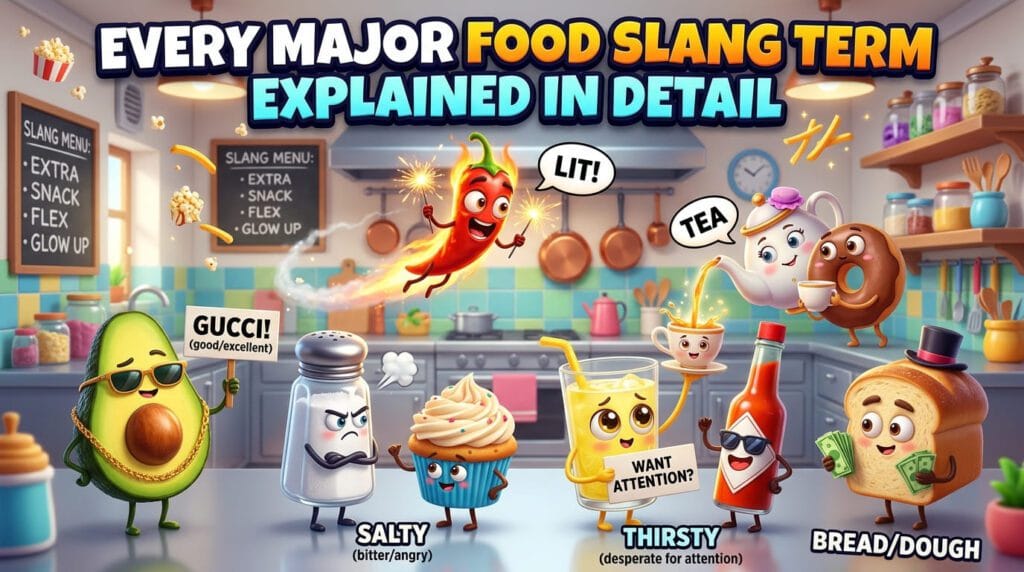
Let’s go through the big ones. Not just quick definitions I want you to really understand each term, how it’s used, where it came from, and the subtle rules around it.
1. Snack
What it means: An attractive person. Someone who looks good enough that you notice them immediately.
The vibe: Light, playful, appreciative without being too intense. Calling someone a snack is a compliment, but it’s a casual one. It suggests attraction without heaviness.
Where it came from: This usage gained traction in the mid-2010s, spreading through Black Twitter and then into mainstream internet culture. It plays on the idea that a snack is something enjoyable but not a full commitment — you’re appreciating someone’s appearance without necessarily implying anything deeper.
How you’d actually hear it:
- “My new neighbor is an absolute snack.”
- “Have you seen the new professor? Snack alert.”
- “She posted new photos and honestly? Certified snack.”
Important nuance: There’s a hierarchy here. A “snack” is attractive. A “whole meal” is next-level attractive. And if someone calls you “a five-course dinner,” just accept the compliment and walk away slowly because that is the highest tier.
2. Bread
What it means: Money. Income. Financial resources. The thing you work for.
The vibe: Hustler energy. When people talk about “bread,” they’re usually talking about ambition, hard work, and financial goals. It carries a sense of grind and determination.
Where it came from: The association between bread and money is actually quite old — “dough” has meant money in slang for over a century, and “bread” follows the same logic. In modern slang, it was revitalized through hip-hop and entrepreneurial culture online.
How you’d actually hear it:
- “I can’t be wasting time I need to secure the bread.”
- “She’s been chasing bread since she was sixteen. Respect.”
- “Forget the drama, focus on your bread.”
Related expressions:
- “Breadwinner” the primary earner
- “Let’s get this bread” motivational phrase meaning let’s go make money
- “Bread and butter” someone’s main source of income or core skill
3. Tea
What it means: Gossip. Inside information. Drama that someone is about to share.
The vibe: Anticipatory and conspiratorial. When someone says “spill the tea,” they’re leaning in, eyes wide, ready to hear something they probably shouldn’t know. It’s intimate and thrilling.
Where it came from: The term “tea” in this context is widely attributed to drag culture and Black queer communities, where it was used long before mainstream adoption. Some trace it to the phrase “T” meaning truth. The Kermit the Frog “but that’s none of my business” meme, showing Kermit sipping tea, helped catapult it into widespread internet usage.
How you’d actually hear it:
- “Girl, I have the hottest tea about what happened at the party.”
- “No one’s spilling the tea and I’m getting frustrated.”
- “The tea is that they’ve been secretly dating for six months.”
Important nuance: “Tea” is always juicy. You don’t “spill the tea” about mundane information. Nobody says “the tea is that I went grocery shopping today.” Tea implies something worth hearing, something that shifts your understanding of a situation.
4. Sauce
What it means: Confidence, style, swagger. That intangible quality that makes someone stand out.
The vibe: Smooth and effortless. Having “sauce” means you’re cool without trying too hard. It’s natural charisma, personal style, and self-assurance all rolled into one.
Where it came from: This one has deep hip-hop roots. Gucci Mane famously used “sauce” throughout his music and persona. The term spread through rap culture and eventually into broader internet slang. It suggests flavor — the idea that someone adds something special to any situation they enter.
How you’d actually hear it:
- “That man has unreal sauce. Look at how he carries himself.”
- “The sauce is in the details the watch, the shoes, the attitude.”
- “You can’t teach sauce. You either have it or you don’t.”
Related expressions:
- “Lost in the sauce” overwhelmed, confused, or too caught up in something
- “Dripping sauce” exuding confidence and style
- “No sauce” boring, lacking personality or flair
5. Salty
What it means: Feeling bitter, annoyed, upset, or resentful usually about something relatively minor.
The vibe: Petty and slightly irrational. Being “salty” implies that your negative feelings are perhaps disproportionate to the situation. It’s not deep sadness or legitimate anger it’s that specific flavor of irritation where you know you should let it go but you just… can’t.
Where it came from: “Salty” has been used as slang since at least the 1930s in American English, originally meaning tough, aggressive, or experienced (particularly in military and naval contexts). Its modern meaning bitter or upset emerged through AAVE and became mainstream through internet culture in the 2010s.
How you’d actually hear it:
- “He’s been salty ever since I beat him at FIFA.”
- “Don’t be salty just because they didn’t invite you.”
- “I could tell she was salty by the way she left the room.”
Important nuance: “Salty” is almost always used about others, rarely about yourself. If someone calls themselves salty, it’s usually self-deprecating. If you call someone else salty, it’s mildly teasing. It’s rarely mean-spirited.
6. Spicy
What it means: Bold, provocative, controversial, or daring. Something that generates a strong reaction.
The vibe: Edgy and exciting. A “spicy” take is one that might get pushback. A “spicy” situation is one where tensions are high. It implies heat the kind that makes you sit up and pay attention.
How you’d actually hear it:
- “That was a spicy opinion to share at a family dinner.”
- “Things got spicy on Twitter after that announcement.”
- “She dropped a spicy comment and then just logged off.”
7. Cheesy
What it means: Overly sentimental, corny, cliché, or trying too hard to be romantic or meaningful.
The vibe: Eye-roll territory, but often affectionate. Calling something “cheesy” can be critical, but it’s frequently used with a smile. Some people love cheese. Some people are proud of their cheesiness.
Where it came from: This usage has been around since at least the mid-20th century. The exact origin is debated, but it may relate to “cheap” (things that are overly produced or insincere feeling cheap, like processed cheese versus the real thing).
How you’d actually hear it:
- “He wrote her a poem and it was so cheesy but honestly kind of sweet.”
- “That movie was cheesy but I cried anyway.”
- “Stop being cheesy and just tell her how you feel normally.”
8. Juicy
What it means: Exciting, scandalous, gossip-worthy. Information or a story that’s too good not to share.
The vibe: Similar to “tea” but focused more on the quality of the information rather than the act of sharing it. Something “juicy” is rich with detail and drama.
How you’d actually hear it:
- “I overheard the juiciest conversation in the break room.”
- “This story gets juicier the more you hear.”
- “Give me the juicy details — don’t skip anything.”
9. Cooked
What it means: Finished. Done for. In serious trouble or completely defeated.
The vibe: Finality and sometimes dark humor. When someone says “I’m cooked,” they’re acknowledging that a situation has gone beyond recovery. It can be serious or dramatically exaggerated for comedic effect.
Where it came from: The metaphor is straightforward — once food is cooked, you can’t un-cook it. The transformation is complete and irreversible. Applied to people, it means the damage is done.
How you’d actually hear it:
- “I just realized the assignment was due yesterday. I’m cooked.”
- “After that scandal came out, his career is cooked.”
- “We’re all cooked if the professor finds out.”
Related expressions:
- “Let him cook” — the opposite energy. This means let someone do their thing, give them space to create or perform. Don’t interrupt genius at work.
- “He’s cooking” — someone is in the zone, producing something great
10. Beef
What it means: A conflict, disagreement, ongoing feud, or personal issue between people.
The vibe: Serious but sometimes performative. “Beef” can range from genuine hostility to exaggerated internet drama. The word implies an ongoing issue rather than a single argument.
Where it came from: “Beef” as slang for conflict has roots going back to at least the 1800s in British and American slang. In modern usage, it was heavily amplified through hip-hop culture, where publicized “beefs” between artists became their own form of entertainment and storytelling.
How you’d actually hear it:
- “What’s the beef between those two? They won’t even look at each other.”
- “I have no beef with anyone. I’m keeping my peace.”
- “Their beef started over something ridiculous and now it’s out of control.”
11. Thirsty
What it means: Desperately seeking attention, validation, or romantic interest. Trying too hard to be noticed.
The vibe: Cringe-inducing. Nobody wants to be called “thirsty.” It implies a lack of self-awareness and dignity. The metaphor works because desperation, like physical thirst, makes you do things you wouldn’t normally do.
How you’d actually hear it:
- “He commented on every single one of her photos. That’s thirsty behavior.”
- “Don’t double-text three times. You’re being thirsty.”
- “The way brands try to go viral is so thirsty sometimes.”
12. Extra
What it means: Over the top, dramatic, doing way more than the situation requires.
The vibe: It can be critical or admiring, depending on context. Some people wear “extra” as a badge of honor. Others use it as a gentle roast.
How you’d actually hear it:
- “She showed up to a casual brunch in a full evening gown. So extra.”
- “I know I’m extra but I brought homemade centerpieces for a movie night.”
- “That reaction was extremely extra but honestly entertaining.”
13. Burnt
What it means: Embarrassed, roasted, or humiliated — usually because someone delivered a devastating verbal comeback.
How you’d actually hear it:
- “She absolutely burnt him with that response.”
- “That joke left the whole room burnt.”
- “I’m still burnt from what she said last week.”
14. Raw
What it means: Unfiltered, authentic, emotionally exposed. Something delivered without polish or pretense.
How you’d actually hear it:
- “That interview was raw. He didn’t hold anything back.”
- “Her lyrics are always so raw and honest.”
- “The documentary was raw — hard to watch but important.”
15. Half-Baked
What it means: An idea or plan that hasn’t been fully thought through. Incomplete, underdeveloped, or poorly conceived.
How you’d actually hear it:
- “Don’t bring a half-baked proposal to the meeting.”
- “His theory sounds half-baked at best.”
- “I had a half-baked idea at 3 AM and now it actually might work.”
16. Simmering
What it means: Quietly angry, holding back frustration, on the verge of boiling over.
How you’d actually hear it:
- “She didn’t say anything but you could tell she was simmering.”
- “He’s been simmering about that comment all day.”
- “The tension in the room was simmering.”
The Subtle Differences Between Similar Slang Words
This is where a lot of people trip up, and I don’t blame them. Many food slang terms seem interchangeable at first glance, but they carry distinctly different energies. Understanding these differences is what separates someone who genuinely understands the language from someone who’s just parroting words they heard online.
“Food” vs. “Fire” vs. “Bussin”
All three mean something is good, but the texture is different.
Food — deeply satisfying, nourishing, fulfilling. Like a meal that makes you close your eyes and just appreciate the moment. It’s calm satisfaction.
Fire — intensely impressive, high-energy, exciting. Like watching something explode in the best way possible. It’s adrenaline and hype.
Bussin — specifically delicious, usually applied to actual food first and then extended metaphorically. It’s more playful and emphatic than “food” or “fire.”
So a beautifully shot film that moves you emotionally? That’s food. An incredible plot twist that makes you gasp? That’s fire. A plate of perfectly seasoned jollof rice? That’s bussin.
“Tea” vs. “Juicy”
Both relate to gossip, but they function differently in a sentence.
Tea is the gossip itself. It’s the noun. “I have tea” means “I have gossip.”
Juicy is a descriptor for the quality of the gossip. “That tea is juicy” means the gossip is especially good, detailed, and dramatic.
You can have tea that isn’t juicy (mild gossip), but juicy almost always implies tea (because what else would be juicy in a conversation context?).
“Salty” vs. “Bitter” vs. “Sour”
All describe negative emotional states, but with different flavors (pun very much intended).
Salty — annoyed about something relatively small, often with a petty edge.
Bitter — deeper resentment, usually about something that genuinely hurt. More serious than salty.
Sour — less common in slang, but when used, it implies someone’s mood has turned negative and is affecting the atmosphere around them. “Things went sour” means things deteriorated.
“Cooked” vs. “Burnt” vs. “Roasted”
All involve heat-based destruction, but the context matters.
Cooked — you’re done for. The situation is beyond saving. It’s about your overall state.
Burnt — you’ve been embarrassed or humiliated, usually by someone’s words. It’s about a specific moment.
Roasted — someone deliberately and publicly made fun of you in a clever, cutting way. It’s about the action someone performed against you.
Where Food Slang Lives and Thrives
Food meaning slang doesn’t exist equally everywhere. It concentrates in specific environments, and knowing where to find it helps you understand how it actually functions in the wild.
TikTok
This is ground zero for modern food slang. The comment sections of popular TikTok videos are a masterclass in current slang usage. Fashion content, dance videos, cooking clips, gaming highlights, transformation reveals scroll through the comments on any of these and you’ll find food slang everywhere.
TikTok’s algorithm also accelerates slang adoption because it exposes content to massive, diverse audiences very quickly. A term can go from niche to mainstream in a matter of days.
Twitter / X
Twitter has always been a breeding ground for linguistic innovation because of its character limit. When you have limited space, you need punchy, efficient language and slang delivers exactly that. “This is food” communicates in three words what might otherwise take a full sentence of conventional praise.
Quote tweets and reply chains are where you’ll see the most creative uses of food slang.
Hip-Hop and R&B
Music remains one of the most powerful distribution channels for slang. When an artist with millions of listeners uses a food term in a track, that word enters the vocabulary of an entire generation almost overnight.
Interviews, social media posts, and live streams by musicians also spread food slang because fans mirror the language of artists they admire.
Gaming Communities
Discord servers, Twitch streams, and gaming subreddits are surprisingly rich sources of food slang. Gamers are heavy slang users in general, and food terms fit naturally into the fast-paced, reaction-heavy nature of gaming culture.
“That play was food.” “He’s cooked.” “Let him cook.” These phrases echo through gaming communities constantly.
Group Chats and Private Conversations
This is where slang feels most natural. In group chats with close friends, food slang flows without any self-consciousness. Nobody’s performing they’re just communicating in the language that feels most natural to their generation and social circle.
If you want to understand how food slang really works, get invited to a Gen Z group chat. It’s a linguistic experience.
My Personal Journey With Food Slang (Including Embarrassing Moments)
After that initial incident with my brother and the biryani, I went through what I can only describe as the three stages of slang adoption.
Stage One: Confusion
For about two weeks, I was constantly encountering food slang and not understanding it. Someone on Twitter would say “this take is absolutely cooked” and I’d wonder if they meant it was good (like well-cooked food) or bad (like overcooked food). Turns out it depends on context, which didn’t help my confusion at all.
I remember reading a comment that said “she ate that and left no crumbs” under a dance video and spending an embarrassing amount of time trying to figure out who was eating what.
Stage Two: Overenthusiastic Adoption
Once I understood the basic terms, I went completely overboard. I started using food slang in every possible situation, including several where it absolutely did not belong.
My worst moment was during a work call when a colleague presented a really solid quarterly analysis and I, without thinking, said “honestly that presentation was food.” The silence that followed still haunts me. My colleague asked if I was hungry. My manager looked confused. I pretended my internet was lagging and muted myself for the rest of the meeting.
Another time, my mother showed me a recipe she was proud of and I told her “this is giving sauce” and she thought I was criticizing her for using too much actual sauce. It took fifteen minutes to explain that I was complimenting her, and by the end of the explanation, the compliment had lost all its energy.
Stage Three: Natural Integration
Eventually, I found my balance. I learned that food slang works best when it’s used naturally, in the right context, with people who share the vocabulary. Forcing it into professional settings or conversations with people who aren’t familiar with it just creates awkward situations.
Now I use food slang the way it’s meant to be used casually, among friends, online, and in contexts where it adds genuine flavor (sorry, couldn’t resist) to the conversation. And I know when to leave it alone.
Situations Where You Should Absolutely Avoid Food Slang
I learned this the hard way, so let me save you the trouble.
Professional Environments
Unless your workplace has an extremely casual culture and you know your audience, keep food slang out of meetings, presentations, emails, and client interactions. Telling your boss that their strategy is “bussin” might get a laugh from one person and a concerned look from everyone else.
Academic Writing
Essays, research papers, formal reports these are not the place. Even if you’re writing about slang as a topic, use the terms analytically rather than adopting them as your own voice in the paper.
Conversations with People Outside the Loop
This includes older relatives, certain professional contacts, and anyone who isn’t active on social media. Using slang they don’t understand doesn’t make you seem cool it makes communication harder, which is the opposite of what language is supposed to do.
When Complimenting Actual Food
This is the trap I mentioned earlier. If someone cooks you a beautiful meal and you say “this is food,” they will look at you like you’ve lost your mind. Because yes, it literally is food. They know that. They made it. The slang meaning gets completely lost because the literal meaning is so obvious.
Sensitive or Serious Conversations
If someone is sharing something genuinely difficult with you a loss, a struggle, a personal crisis responding with slang feels dismissive even if you mean well. Read the room. Some moments call for direct, sincere language, not internet-inflected shorthand.
Content That Needs to Stay Relevant Long-Term
Slang ages faster than almost any other aspect of language. A blog post, brand tagline, or marketing campaign built heavily around current food slang might feel dated within a year or two. If you’re creating something meant to endure, use slang sparingly or not at all.
Why Food Meaning Slang Is More Important Than You Think
I know some people dismiss all slang food-related or otherwise as lazy communication, a degradation of “proper” language, a sign that younger generations can’t express themselves articulately.
With enormous respect to those people, they’re wrong.
Slang Is Linguistic Innovation
Every living language evolves. The English you speak today would be unrecognizable to someone from three hundred years ago, and the English spoken three hundred years from now will be equally foreign to us. Slang is one of the primary engines of that evolution.
When someone takes the word “salty” a term for a specific taste sensation and repurposes it to describe a complex emotional state involving bitterness, pettiness, and mild resentment, that’s not lazy. That’s creative. That’s a person recognizing that existing vocabulary doesn’t perfectly capture what they want to express, and inventing a new usage to fill the gap.
Food meaning slang is literally language doing what language is supposed to do: evolving to meet the communication needs of its users.
Slang Builds Community
Using the same slang as someone else creates an instant sense of belonging. It signals shared cultural knowledge, generational identity, and social awareness. When you use food slang correctly in the right context, you’re not just communicating information — you’re communicating “I’m one of you. I understand this world. I belong here.”
This is especially powerful online, where you can’t rely on body language, tone of voice, facial expressions, or physical proximity to establish connection. Words become your primary tool for building social bonds, and slang is the most efficient version of that tool.
Slang Reflects Culture
The slang a society creates tells you an enormous amount about what that society values, fears, celebrates, and obsesses over. The fact that so much modern slang comes from food tells us something important: food is one of the most universal, emotionally resonant experiences humans share.
We use food metaphors because food is intimate. It’s sensory. It’s deeply tied to memory, identity, community, and love. When we say someone has “sauce,” we’re drawing on the idea that flavor is something inherently valuable that adding something unique and distinctive to any situation is a quality worth celebrating.
Understanding Slang Is a Communication Skill
If you interact with anyone under thirty whether as a parent, teacher, manager, marketer, content creator, or just a human being who exists in the modern world understanding food meaning slang isn’t optional. It’s a communication skill.
You don’t have to use it yourself. But understanding it means you won’t misinterpret what someone is saying, you won’t feel excluded from conversations, and you’ll be able to connect with people across generational lines more effectively.
How Food Slang Connects to Culture, Identity, and Belonging
This deserves its own section because it’s something I feel strongly about.
Food slang doesn’t exist in a vacuum. It comes from specific communities primarily Black American communities, queer communities, hip-hop culture, and immigrant cultures and when it spreads into the mainstream, something complicated happens.
On one hand, the spread of food slang is a testament to the creative power of these communities. Their linguistic innovations are so compelling, so perfectly crafted, that they get adopted by millions of people worldwide. That’s influence. That’s cultural impact.
On the other hand, the adoption often happens without credit. People use terms like “tea” and “salty” without any awareness of where they originated. The communities that created these words sometimes see their language stripped of its context and used by people who don’t understand its cultural significance.
Being a responsible user of food slang means being at least somewhat aware of its origins. It means not claiming ownership of language you didn’t create. It means appreciating the communities whose creativity gave you these expressions.
This doesn’t mean you can’t use food slang. Language is meant to be shared. But use it with awareness, not just as a trend to follow blindly.
The Psychology Behind Why We Turn Food Into Metaphors
I want to get a little deeper here because this question genuinely fascinates me.
Why food? Of all the things humans could use as a source for metaphorical language, why does food show up so consistently?
Embodied Cognition
There’s a concept in psychology called embodied cognition the idea that our thinking is deeply influenced by our physical experiences. We don’t process language as pure abstraction. Our bodies are involved.
When you read the word “sweet,” your brain activates some of the same neural pathways involved in actually tasting sweetness. This means food-based language carries a sensory punch that abstract language doesn’t. It’s more vivid, more immediate, and more emotionally engaging.
Universal Accessibility
Not everyone has experienced a stock market crash or a philosophical crisis. But everyone has eaten food they loved. Everyone has tasted something too salty, too spicy, too bitter, or perfectly balanced.
Food experiences are so universal that food-based metaphors require almost zero explanation. They tap into a shared human database of sensory memories.
Emotional Associations
Food is deeply emotional for most people. It’s tied to family, celebration, comfort, childhood memories, cultural identity, and love. When we use food words in non food contexts, we’re unconsciously invoking all of those emotional associations.
Calling someone “a snack” isn’t just saying they’re attractive. It’s saying they evoke the same kind of simple, immediate pleasure that a favorite snack does. Saying someone has “beef” isn’t just saying they have a conflict. It’s suggesting the conflict is substantial, meaty, significant not a trivial disagreement.
Compression of Complex Ideas
Slang serves as emotional shorthand. Saying “I’m salty” compresses an entire paragraph of emotional explanation “I feel upset about this situation in a way that I know might be slightly irrational, but I can’t help feeling annoyed and bitter even though I wish I could let it go” into two words.
That compression is incredibly useful in fast-paced digital communication where attention spans are short and character counts matter.
Food Slang Across Different Countries and Languages
One thing that surprised me during my research is how widespread food-based slang is across languages. It’s not just an English phenomenon.
Hindi and Urdu
In South Asian communities, food slang has its own rich tradition. Calling someone “mirchi” (chili) can mean they’re feisty or hot-tempered. “Meetha” (sweet) can describe someone who’s pleasant or, in some contexts, carries different connotations entirely. The phrase “namak halal” (being true to someone’s salt) speaks to loyalty and gratitude.
Spanish
“Estar como un queso” (to be like a cheese) means to be attractive in some Spanish-speaking regions. “Dar calabazas” (to give pumpkins) means to reject someone romantically.
French
“Raconter des salades” (to tell salads) means to tell lies or exaggerated stories. The metaphor of mixing ingredients into a salad maps onto the idea of mixing truth with fiction.
Japanese
“KY” (kuuki yomenai) literally means “can’t read the air” but food-related slang exists too — calling something “oishii” (delicious) in contexts unrelated to food to mean something is really good or satisfying.
Arabic
“Dammu khafeef” (light-blooded) describes someone with a pleasant, likeable personality. Food and body-based metaphors intertwine regularly in Arabic slang.
The universality of food-based metaphorical language across cultures reinforces the point: food is one of the deepest wells of shared human experience, and every language draws from it naturally.
Complete Food Slang Glossary
Here’s an expanded reference for every food-related slang expression worth knowing:
| Expression | Meaning | Usage Level |
|---|---|---|
| Snack | Attractive person | Very Common |
| Whole Meal | Extremely attractive person | Common |
| Full Course | Peak attractiveness | Less Common |
| Bread | Money | Very Common |
| Dough | Money (older slang, still used) | Common |
| Cheddar | Money | Moderate |
| Cake | Money (also: an attractive body) | Common |
| Tea | Gossip, information | Very Common |
| Sauce | Confidence, style, swagger | Very Common |
| Salty | Bitter, upset, annoyed | Very Common |
| Spicy | Bold, controversial, provocative | Common |
| Cheesy | Corny, overly sentimental | Very Common |
| Juicy | Exciting, scandalous | Common |
| Cooked | Finished, done for | Very Common |
| Let him cook | Give them space to perform | Very Common |
| Beef | Conflict, feud | Very Common |
| Thirsty | Desperate for attention | Very Common |
| Extra | Over the top, dramatic | Very Common |
| Burnt | Embarrassed, roasted | Common |
| Raw | Unfiltered, authentic | Common |
| Half-baked | Poorly thought out | Common |
| Simmering | Quietly angry | Moderate |
| Toasted | Mildly embarrassed or mocked | Less Common |
| Buttered up | Flattered excessively | Common |
| Stewing | Overthinking angrily | Moderate |
| Crispy | Clean, sharp, well-executed | Emerging |
| Baked | Under the influence (informal) | Common |
| Fried | Exhausted, mentally drained | Common |
| Marinated | Having processed something over time | Emerging |
| Ate (and left no crumbs) | Performed flawlessly | Very Common |
| Feeding | Delivering great content consistently | Common |
| Bussin | Exceptionally good (especially food) | Very Common |
| Gravy | Easy, smooth, no problems | Common |
Frequently Asked Questions
What does “food” mean in slang?
In slang contexts, “food” can mean several different things depending on who’s using it and where. Most commonly, it refers to something that is excellent, deeply satisfying, or high quality the way a perfect meal satisfies you on every level. In some communities, it can also refer to an easy target (particularly in street slang), money, or anything that nourishes you figuratively. Context is everything with this term.
Why do people use food words as slang?
Food is one of the most universal human experiences. Everyone eats. Everyone understands what different tastes and textures feel like. This makes food vocabulary incredibly effective as metaphorical language when you call something “spicy,” people instantly understand the intensity you’re describing without needing further explanation. Food words carry sensory and emotional weight that abstract vocabulary simply doesn’t match.
Is “snack” a compliment or is it disrespectful?
Calling someone “a snack” is generally meant as a compliment it means the person is attractive and appealing. However, like any comment about someone’s appearance, context and delivery matter enormously. Used between friends or in casual online spaces, it’s lighthearted and playful. Used toward a stranger in person, it might feel objectifying or unwelcome. Always read the situation before dropping this one.
What does “let him cook” mean?
“Let him cook” means give someone the space and freedom to do their thing without interference. If someone is in the zone whether they’re creating music, building something, giving a presentation, or making a point in an argument “let him cook” is a vote of confidence. It says: “Don’t interrupt. They’re onto something. Let the process play out.”
Where does food slang come from originally?
The majority of modern food slang in English originates from African American Vernacular English (AAVE) and Black cultural communities, with significant contributions from hip-hop culture, drag and queer communities, and internet meme culture. These communities have historically been engines of linguistic innovation, creating expressions that eventually get adopted into mainstream usage through music, social media, and pop culture.
Is food slang only used by young people?
While Gen Z and younger millennials are the heaviest users of contemporary food slang, many food-based expressions have crossed generational lines. Terms like “salty,” “cheesy,” “beef,” and “spicy” are understood and used by people of all ages. The newer, more niche terms tend to stay concentrated among younger demographics and active internet users, but the overall phenomenon of using food words metaphorically is universal and ageless.
Can food slang be used in professional settings?
Generally, it’s best to avoid food slang in formal professional environments unless you know your audience extremely well. Casual workplace cultures, creative industries, and teams with younger demographics may be more receptive, but even then, read the room. There’s a significant difference between joking with close coworkers and using slang in a client presentation.
How quickly does food slang change?
Very quickly. Some terms have staying power “salty,” “beef,” and “tea” have been in circulation for years and show no signs of fading. Others emerge, peak, and decline within months. The pace of social media means new slang can go from obscure to ubiquitous to outdated faster than ever before. The best approach is to stay observant rather than trying to memorize a fixed list.
What’s the difference between “cooked” and “let him cook”?
These two expressions use the same word but convey opposite energies. “Cooked” (as in “he’s cooked”) means someone is finished, defeated, or in irreversible trouble. “Let him cook” means someone is in the creative zone and should be given space to produce something great. One is about destruction, the other about creation. Context makes the difference completely clear.
Does food slang exist in languages other than English?
Absolutely. Virtually every language on earth uses food-based metaphors in its slang and colloquial expressions. Hindi, Arabic, Spanish, French, Japanese, Korean all of these languages have rich traditions of turning food vocabulary into metaphorical language. The specific terms differ, but the underlying human instinct to describe the world through food is universal.
Final Thoughts
Food meaning slang is one of those corners of language that, once you notice it, you realize it’s been everywhere all along. It’s in your group chats, your social media feeds, your favorite songs, your conversations with friends, and probably even in your own speech patterns without you consciously recognizing it.
What makes food slang so enduring so resistant to becoming just a passing trend is its foundation in universal human experience. We all eat. We all know what flavors feel like. We all have emotional relationships with food that go far beyond nutrition. When language taps into something that fundamental, it sticks.
But food slang is also more than just clever wordplay. It’s a window into how communities create culture through language. It shows us how Black communities, queer communities, immigrant communities, and internet communities generate creative innovations that eventually reshape how everyone communicates. Understanding that flow appreciating where these words come from, not just what they mean is part of being a thoughtful participant in shared culture.
I started this journey confused by my brother’s comment about biryani. I went through an awkward phase of trying too hard. And I eventually arrived at a place where food slang feels natural in the right moments and where I know when to set it aside.
That journey taught me something broader about language: the goal isn’t to sound a certain way. The goal is to communicate genuinely with the people around you. Sometimes that means using “food” to describe a beautiful piece of music. Sometimes it means just saying “that was really good.” Both are valid. Both have their place.
Language is a living thing. It grows, it shifts, it surprises you. Food slang is just one delicious corner of that ongoing evolution — and honestly? It’s pretty satisfying.
The next time someone tells you something is “food” and there’s no plate in sight, you’ll know exactly what they mean. And maybe, just maybe, you’ll smile a little the way I did once I finally got the joke.
Food meaning slang continues to evolve every single day. New expressions emerge, old ones fade, and the beautiful cycle of linguistic creativity keeps turning. Stay curious, stay aware, and most importantly — let the language cook.