
If you’ve ever walked past a group of pre-med students huddled over textbooks in the library, chances are you’ve heard someone groan about “orgo.” Maybe you saw it pop up on a Reddit thread, a TikTok comment section, or a friend’s frustrated text message. But if you’re not deep in the world of science education, you might be wondering — what does orgo actually mean in slang?
Don’t worry, you’re not alone. The term might sound like some trendy internet buzzword, but it actually has deep roots in university culture. And once you understand it, you’ll start noticing it everywhere.
In this comprehensive guide, we’re going to break down the orgo meaning slang in a way that’s easy to digest, genuinely helpful, and packed with everything you need to know — from its origins and evolution to how it’s used in everyday conversation, study groups, social media, and beyond.
What Does Orgo Mean in Slang?

Let’s start with the basics. When someone says “orgo,” they’re using a casual, shortened version of the phrase organic chemistry. That’s it — simple, right? But the simplicity of the word is exactly what makes it so powerful.
Organic chemistry is one of those courses that carries a heavy reputation in the academic world. It’s dense, it’s demanding, and it requires a completely different way of thinking compared to general chemistry. So when students needed a quick way to reference this beast of a subject, they naturally chopped it down to something more manageable: orgo.
But here’s the thing — orgo isn’t just a shorthand. Over the years, it has evolved into something much bigger than a mere abbreviation. It’s become a cultural marker, a word that instantly signals shared experience, mutual suffering, and a kind of academic solidarity. When someone says “I have orgo tonight,” there’s an unspoken understanding behind those words. It means late nights, flash cards, molecular models, and probably a fair amount of stress.
In the slang universe, orgo carries emotional weight. It’s not just referring to a class — it’s referencing an entire experience that millions of science students around the world go through every semester.
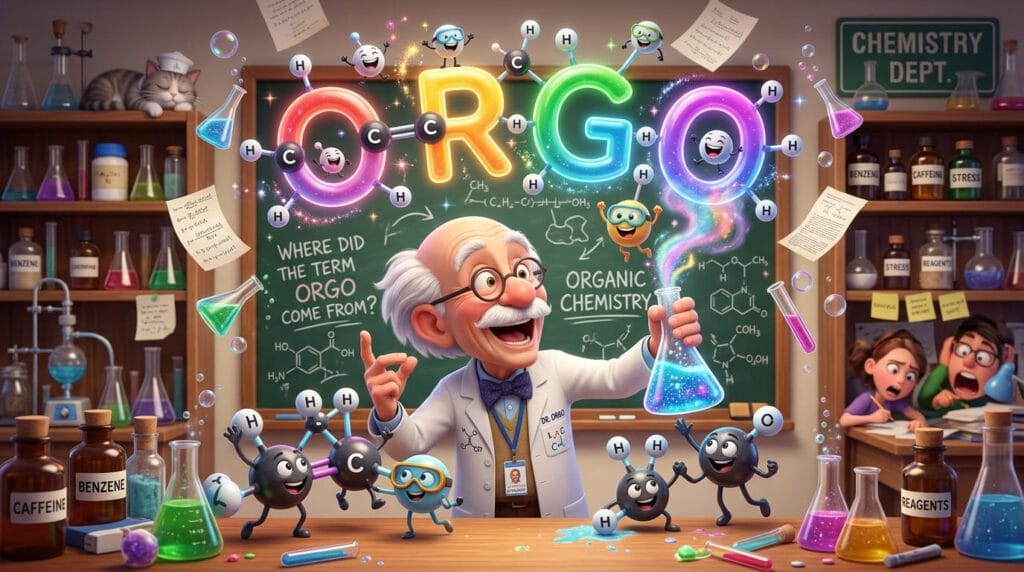
Where Did the Term Orgo Come From?
The exact moment someone first shortened “organic chemistry” to “orgo” is impossible to pin down, and honestly, that’s part of its charm. It wasn’t coined by a linguist or popularized by a celebrity. It grew organically — pun absolutely intended — from the mouths of students who were simply tired of saying the full name over and over again.
Think about it. When you’re rushing between classes, texting your study group, or complaining to your roommate about your homework load, saying “organic chemistry” every single time is exhausting. It’s four syllables too many when you’re already running on three hours of sleep and two cups of coffee.
So students did what humans always do with language — they trimmed it down. Some campuses favored “orgo,” while others leaned toward “o-chem” or “ochem.” But across many universities, particularly in the United States and Canada, “orgo” became the dominant slang term.
The term likely gained traction in the late 20th century as organic chemistry courses became standard requirements for pre-medical, pre-dental, and pre-pharmacy tracks. As more and more students funneled through these programs, the shared vocabulary grew. And “orgo” sat right at the center of it.
With the rise of the internet in the early 2000s and the explosion of social media in the 2010s, orgo slang spread even faster. Suddenly, it wasn’t just a campus thing — it was a global student language.
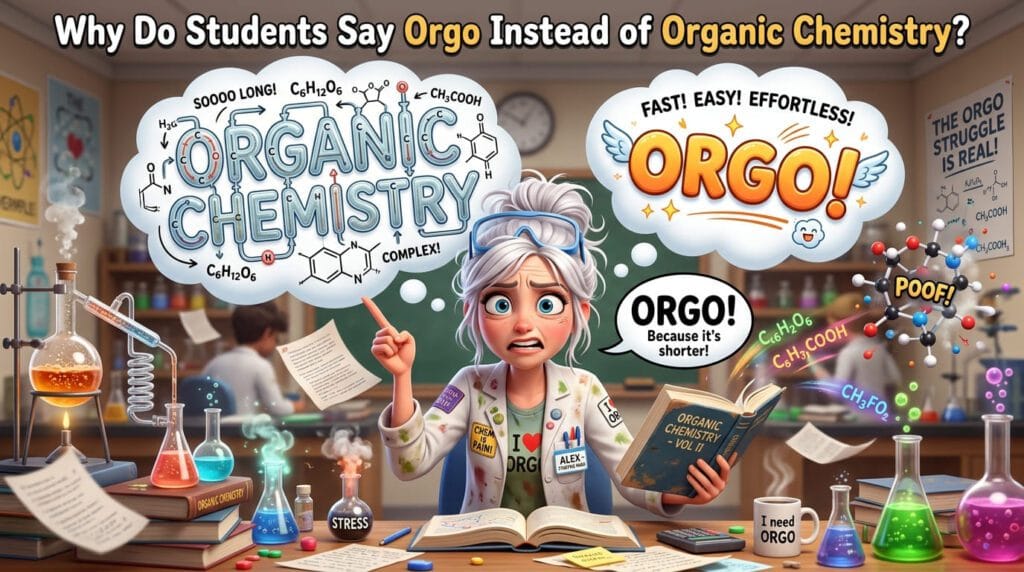
Why Do Students Say Orgo Instead of Organic Chemistry?
You might think it’s purely about convenience, and yes, that’s a big part of it. But the reasons students gravitate toward “orgo” go deeper than just saving a few syllables.
It Creates Instant Connection
When you say “orgo” to another student, there’s an immediate bond. You both know what the other person is going through. It’s like a secret handshake, except instead of shaking hands, you’re both quietly acknowledging that you’ve spent way too long staring at Newman projections.
It Softens the Intimidation Factor
Organic chemistry sounds scary. It sounds like something only geniuses study. But “orgo”? That sounds approachable. It sounds like something you can handle, even on your worst day. By giving the subject a friendlier nickname, students unconsciously make it feel less overwhelming.
It’s Faster in Conversation
In the age of texting, tweeting, and rapid-fire group chat messages, brevity is king. “Orgo” fits neatly into a text message, a meme caption, or a quick comment on a study forum. It’s efficient, and efficiency matters when you’re juggling five courses and a part-time job.
It Signals Insider Knowledge
Using “orgo” tells others that you’re part of the club. You’re not an outsider looking in — you’re someone who has lived the experience. This insider language builds community and strengthens social bonds among students.
How Orgo Became a Cultural Phenomenon on Campus

Walk into any university bookstore, and you might find mugs, T-shirts, or stickers with phrases like “I Survived Orgo” or “Orgo Is My Cardio.” The word has transcended its role as simple slang and become part of campus culture itself.
Here’s how that happened.
The Shared Struggle Narrative
Organic chemistry is notoriously difficult. It’s the course that makes or breaks pre-med dreams. Because of this, students have built an entire narrative around surviving it. And at the heart of that narrative sits the word “orgo.” It’s not just a class — it’s a rite of passage.
Memes and Internet Culture
The internet loves a good struggle, and orgo provides endless material. Memes about failing orgo exams, pulling all-nighters before orgo finals, and questioning life choices because of orgo have flooded platforms like Reddit, Instagram, TikTok, and Twitter. Each meme reinforces the word and spreads it to new audiences.
Peer-to-Peer Influence
When freshmen arrive on campus and hear upperclassmen talking about “orgo” with a mix of dread and pride, they absorb the term instantly. By the time they’re enrolled in the course themselves, the slang feels completely natural. It’s passed down from generation to generation of students, much like any cultural tradition.
Study Culture
Study groups, tutoring centers, and office hours all use orgo slang freely. When an entire ecosystem of learning revolves around informal communication, the slang becomes embedded in the academic experience itself.
Orgo and Its Connection to Student Struggles

One thing that makes the orgo meaning slang so interesting is its deep connection to the emotional landscape of student life. This isn’t just a fun abbreviation — it’s a word that carries weight.
For many students, organic chemistry represents their biggest academic challenge. It requires spatial thinking, memorization of countless reactions, and an understanding of mechanisms that can feel impossibly abstract at first. The dropout rates in orgo courses are famously high, and the pressure it places on students — especially those aiming for medical school — is enormous.
So when someone uses the word “orgo,” they’re often communicating more than just a subject name. They might be expressing frustration, seeking solidarity, or simply venting about a tough week. The slang becomes a vehicle for emotional expression, which is part of why it has stuck around so persistently.
Consider this scenario: a student posts on social media, “Orgo is destroying me this semester.” Anyone who has taken the course immediately understands the depth of that statement. It’s not hyperbole — it’s a genuine expression of academic struggle, wrapped in a single, punchy word.
Common Slang Terms That Go Hand-in-Hand with Orgo
Orgo doesn’t exist in a vacuum. It’s part of a broader ecosystem of academic slang that students use to navigate organic chemistry. Here are some of the most common terms you’ll encounter alongside orgo, along with what they actually mean:
Course-Related Slang
- O-Chem / OChem — Another popular abbreviation for organic chemistry, used interchangeably with orgo on many campuses
- Org Chem — A slightly longer but still informal version
- Orgo Lab — Refers specifically to the laboratory component of the course
- Orgo Final — The dreaded final exam in organic chemistry
- Orgo Exam — Any test or midterm in the course
- Orgo Class — The lecture portion of the course
Reaction and Mechanism Slang
- SN1 / SN2 — Shorthand for nucleophilic substitution reactions (Type 1 and Type 2), two of the most fundamental reaction types in organic chemistry
- E1 / E2 — Abbreviations for elimination reactions, another cornerstone of the subject
- Elim — Casual shorthand for elimination reaction
- Mech — Short for mechanism, referring to the step-by-step process of how a reaction occurs
- Curly Arrows — The curved arrows drawn in mechanisms to show electron movement; a defining visual tool in organic chemistry
- Proton Shuffle — A lighthearted term for acid-base proton transfer reactions
- Nuc — Short for nucleophile, a species that donates electrons in a reaction
- Elec — Short for electrophile, a species that accepts electrons
- Reags — Casual abbreviation for reagents, the chemicals used to carry out reactions
- Carbocation — While technically a proper chemistry term, students use it so frequently in casual conversation that it functions as slang in study group contexts
Emotional and Humorous Slang
- Orgo Brain — The feeling of mental exhaustion after studying organic chemistry for too long
- Orgo Survivor — Someone who has successfully completed the course
- Death by Orgo — A dramatic way of saying the course is extremely difficult
- Arrow Pushing — Technically a real technique, but students often use it humorously to describe the sometimes tedious process of drawing out mechanisms
These terms form a rich vocabulary that students tap into daily. Together, they create a language that is efficient, humorous, and deeply connected to the experience of studying organic chemistry.
Orgo Meaning Slang in Text Messages and Social Media
In today’s digital world, slang lives and breathes online. And orgo is no exception. The way students use this term in texts, tweets, and posts reveals a lot about its cultural significance.
In Text Messages
Text conversations between students are where orgo slang thrives most naturally. Here are some typical examples:
- “Can’t hang out tonight, gotta study for orgo 😩”
- “Did you understand the SN2 stuff from today’s orgo lecture?”
- “Orgo lab was a disaster lol my product was the wrong color”
- “Anyone wanna form an orgo study group for the midterm?”
Notice how the word functions as both a noun (the subject itself) and an adjective (orgo lab, orgo study group). This flexibility is part of what makes it such effective slang.
On Social Media Platforms
On platforms like TikTok, Instagram, Reddit, and Twitter, orgo has become a content category unto itself. Students create videos about their orgo struggles, share study tips using orgo terminology, and post memes that resonate with anyone who has taken the course.
Popular hashtags include #orgo, #orgochem, #organicchemistry, and #orgolife. These tags connect students across different schools and even different countries, building a global community united by a shared academic experience.
Reddit communities like r/premed and r/chemistry are filled with posts using orgo slang. Students ask for advice, share resources, and commiserate about difficult exams — all using the informal language that has become second nature to them.
On YouTube and Educational Platforms
Even educational content creators have embraced orgo slang. Tutors title their videos things like “How to Ace Orgo” or “Orgo SN2 Reactions Explained” because they know students search for the course using its slang name. This crossover between informal slang and formal education is a fascinating example of how language evolves in the digital age.
Real-Life Examples of Orgo Slang in Conversation
To really understand how orgo slang works in practice, let’s look at some realistic scenarios where students might use these terms.
In a Study Group
Student A: “Okay, let’s go over the E2 mechanism one more time. I keep confusing it with E1.”
Student B: “Sure. Remember, E2 is one step — the base grabs the proton and the leaving group exits at the same time. Think of it as everything happening in one smooth motion.”
Student A: “Right, and E1 is two steps. Carbocation forms first.”
Student B: “Exactly. And watch your arrows — the curly arrows need to show the electron flow correctly.”
In a Group Chat
Message 1: “Orgo exam tomorrow and I haven’t even started reviewing alkenes 💀”
Message 2: “Same. The reags for Markovnikov addition are killing me.”
Message 3: “Just remember: HBr without peroxides = Markovnikov. With peroxides = anti-Markovnikov. You got this!”
In a Casual Conversation
Friend 1: “How’s your semester going?”
Friend 2: “Honestly? Orgo is taking over my life. I literally dream about mechanisms now.”
Friend 1: “Ha, classic orgo brain. You’ll survive, everyone does eventually.”
On a Social Media Post
Caption: “Day 47 of orgo: I now see curly arrows in my sleep. Send help. Or coffee. Preferably both. ☕📚 #orgolife #premedproblems”
These examples show how naturally orgo slang integrates into everyday communication. It’s not forced or artificial — it flows as part of authentic student dialogue.
Orgo Slang Across Different Universities and Countries
While “orgo” is the most widely recognized abbreviation, it’s worth noting that different campuses and different countries have their own variations. This regional diversity adds richness to the slang landscape.
United States
In the U.S., “orgo” is dominant, particularly on the East Coast and at large research universities. Some schools on the West Coast tend to prefer “o-chem” or “ochem,” though both terms are understood universally.
Canada
Canadian students generally follow similar patterns to their American counterparts, with “orgo” being widely used across major universities. The term appears frequently in Canadian student forums and social media.
United Kingdom
In the UK, organic chemistry is often simply referred to as “organic” or “org chem.” The abbreviation “orgo” is less common but is gaining traction thanks to the global influence of American student culture online.
Australia
Australian students typically say “org chem” or “organic,” though exposure to American study content on YouTube and Reddit has introduced “orgo” to many Australian campuses as well.
International Online Communities
In global online spaces, “orgo” has become the default shorthand, largely because so much English-language educational content originates from American creators. Students from non-English-speaking countries who study chemistry in English often adopt the term naturally.
This global spread of orgo slang is a testament to the power of shared academic experiences transcending geographical boundaries.
How Orgo Slang Helps Students Cope with Academic Pressure
Let’s be real — organic chemistry is stressful. The course has a reputation for being a gatekeeper in science education, particularly for students pursuing careers in medicine, dentistry, pharmacy, and related fields. A poor grade in orgo can feel like the end of the world.
In this high-pressure environment, slang serves as a coping mechanism. Here’s how:
It Normalizes the Struggle
When everyone around you is using terms like “orgo brain” or joking about “death by orgo,” the struggle feels less isolating. You realize that you’re not the only one finding it difficult, and that realization can be incredibly comforting.
It Adds Lightness to Heavy Topics
Calling a proton transfer a “proton shuffle” doesn’t change the chemistry, but it does change how you feel about it. Humor makes difficult material more approachable, and approachable material is easier to learn.
It Builds Support Networks
Shared language creates shared identity. When students bond over orgo slang, they’re more likely to form study groups, share resources, and support each other through tough exams. These social connections are crucial for academic success.
It Provides Emotional Release
Sometimes you just need to vent. Posting “orgo is ruining my life” on Twitter isn’t a cry for help — it’s an emotional release valve. And the responses from fellow students who understand exactly what you mean provide validation and support.
The Role of Humor in Orgo Slang
Humor is the heartbeat of orgo slang. Without it, the terms would be dry abbreviations with no cultural resonance. But because students infuse their language with wit, sarcasm, and self-deprecating comedy, orgo slang becomes something memorable and meaningful.
Classic Orgo Humor
- “Organic chemistry is the only place where alcohol is a problem AND a solution.”
- “I asked my orgo professor for extra credit. He gave me a benzene ring and told me to push arrows.”
- “My relationship status: in a committed relationship with orgo. It’s complicated.”
Why Humor Matters in Learning
Research in educational psychology has shown that humor can enhance memory retention and reduce anxiety. When students associate a funny term or joke with a chemical concept, they’re more likely to remember it during an exam. Orgo slang, with its playful terminology and comedic undertones, taps into this principle naturally.
Meme Culture and Orgo
The overlap between meme culture and orgo slang is significant. Memes about organic chemistry are shared millions of times across social media platforms, creating a feedback loop where humor reinforces the slang and the slang fuels more humor. This cycle keeps the language fresh, evolving, and relevant to each new generation of students.
Orgo Slang in Online Communities and Forums
Online communities have played a massive role in spreading and standardizing orgo slang. Platforms where students gather to discuss their courses have become incubators for new terms and expressions.
Subreddits like r/premed, r/chemistry, r/OrganicChemistry, and r/college are filled with orgo slang. Students post questions like “How do I survive orgo 2?” or “Best resources for learning SN1 vs SN2?” These posts use slang naturally and attract responses from students who speak the same language.
Discord
Many universities have Discord servers where students organize study sessions, share notes, and discuss coursework. Orgo slang is the default mode of communication in these spaces, where formality takes a backseat to efficiency and camaraderie.
Quora and Stack Exchange
On question-and-answer platforms, students and professionals alike use orgo slang when discussing organic chemistry topics. While the answers tend to be more formal, the questions often arrive in slang form, reflecting how students naturally think about the subject.
YouTube Comment Sections
Under popular organic chemistry tutorial videos, the comment sections are treasure troves of orgo slang. Students thank creators for “making orgo make sense,” share their own tips using shorthand, and crack jokes about the difficulty of the material.
Should You Use Orgo Slang in Professional Settings?
This is an important question, and the answer depends entirely on context.
When It’s Appropriate
- Study groups and peer discussions — Absolutely. This is the natural habitat of orgo slang.
- Casual conversations with classmates — Go for it. It strengthens social bonds and makes communication faster.
- Social media posts — If you’re posting about your student experience, slang is perfectly fitting.
- Informal emails to classmates — Using “orgo” in a quick message to a study partner is completely fine.
When It’s Not Appropriate
- Lab reports and academic papers — Always use formal terminology. “Organic chemistry” and proper reaction names should be written in full.
- Professional presentations — In conferences, interviews, or formal academic settings, stick to standard language.
- Communications with professors — While some professors might appreciate the informal touch, it’s safer to use proper terms unless you know them well.
- Job applications and cover letters — Even if you’re applying for a chemistry-related position, professionalism demands formal language.
The key takeaway here is that knowing both registers — the formal and the informal — gives you flexibility. You can switch between them depending on your audience, which is a valuable communication skill in any field.
How Professors and Educators View Orgo Slang
You might wonder what the people teaching organic chemistry think about all this slang. The truth is, opinions vary.
The Supportive Camp
Many professors embrace orgo slang because they recognize its value in student engagement. They understand that when students give informal names to concepts, it often means they’re actively processing the material. Some professors even use slang in their own lectures to build rapport with students.
A professor might say, “Alright, let’s look at this SN2 mechanism — remember, it’s the ‘backside attack’ one,” using both the formal abbreviation and a memorable informal description.
The Cautious Camp
Other educators worry that over-reliance on slang might lead to imprecise understanding. If a student always thinks of a reaction by its nickname, they might struggle when they encounter the formal terminology in research papers or standardized exams. These professors encourage slang in casual settings but insist on proper language in academic work.
The Practical Camp
Most professors fall somewhere in the middle. They don’t mind slang in conversation but expect formal language in written assignments. This balanced approach acknowledges the reality of student culture while maintaining academic standards.
How to Respond When Someone Uses Orgo Slang
If you’re new to the world of organic chemistry slang and someone throws a term at you that you don’t recognize, here are some practical tips:
Don’t Pretend to Understand
If someone mentions a term like “proton shuffle” and you’re not sure what they mean, just ask. Most students are happy to explain, and it’s better to clarify than to stay confused.
Mirror the Language
If you do understand the slang, use it back. This shows engagement and builds connection. For example, if someone says, “I’m stuck on the E1 mech,” you might respond, “Which part — the carbocation formation or the elimination step?”
Use It as a Learning Opportunity
Every piece of slang corresponds to a real concept. When you encounter a new term, take a moment to learn the underlying chemistry. This dual approach — learning the slang and the science simultaneously — can actually enhance your understanding.
Be Mindful of Context
If you’re in a formal setting, translate the slang into proper terminology. If someone says, “The nuc attacks the elec,” you might write in your notes, “The nucleophile attacks the electrophile.” This practice helps you become fluent in both languages.
The Broader Impact of Academic Slang Like Orgo
Orgo slang is part of a much larger phenomenon: the creation of informal academic language by students. Every field has its own version of this — medical students have their own shorthand, law students have theirs, and engineering students develop their own set of abbreviations and nicknames.
Language as Community Builder
Academic slang creates in-groups. When you share a vocabulary with someone, you share an identity. This sense of belonging is crucial for student well-being, especially in demanding programs where isolation and burnout are real risks.
Language as a Learning Tool
When students create their own terms for concepts, they’re engaging in active learning. They’re processing information, finding patterns, and making connections — all of which are cognitive activities that promote deeper understanding.
Language as Cultural Archive
Orgo slang preserves the student experience across generations. When a current student uses the same term that someone used twenty years ago, there’s a thread of continuity that connects them. This shared language becomes a kind of cultural archive, documenting the evolving relationship between students and the subjects they study.
Language as Resistance
In some ways, academic slang is a form of gentle resistance against the formality and rigidity of traditional education. By creating their own language, students assert their agency and reshape the learning experience on their own terms. It’s a small act of creativity within a structured system, and it matters more than most people realize.
The Future of Orgo Slang
As long as organic chemistry remains a challenging and widely taught course, orgo slang will continue to evolve. New terms will emerge as new teaching methods, technologies, and cultural trends influence how students communicate.
AI and Orgo Slang
With the rise of AI-powered study tools and tutoring platforms, there’s an interesting question about whether these tools will adopt orgo slang. Some already do — AI tutors that understand when a student types “orgo” instead of “organic chemistry” are already providing more natural, relatable interactions.
Virtual Learning Communities
As more learning moves online, the digital spaces where orgo slang thrives will continue to expand. Virtual study rooms, online tutoring sessions, and global student communities will keep the language alive and spreading.
New Generations, New Terms
Each generation of students brings fresh creativity to the table. Future orgo slang might include terms we can’t even imagine yet, shaped by the memes, platforms, and cultural moments of their time. The core function — making organic chemistry more approachable and communal — will remain the same.
Frequently Asked Questions About Orgo Meaning Slang
What is the orgo meaning in slang?
In slang, “orgo” is an informal abbreviation for organic chemistry. It’s used by students to refer to the course, the subject matter, or the overall experience of studying organic chemistry. The term carries emotional weight, often implying the difficulty and intensity associated with the subject.
Is orgo slang only used in the United States?
While “orgo” is most commonly used in the U.S. and Canada, it has spread to other English-speaking countries and even non-English-speaking countries through online educational content. Other variations like “o-chem” and “org chem” are used in different regions, but “orgo” is increasingly recognized globally.
Can I use orgo slang in my college assignments?
No, it’s best to use formal terminology in academic assignments, lab reports, and exams. Orgo slang is appropriate for informal settings like study groups, text messages, and social media. Understanding both the slang and the formal terms gives you the flexibility to communicate effectively in any context.
Why is organic chemistry called orgo and not something else?
The abbreviation “orgo” was naturally created by students who wanted a shorter, more casual way to refer to organic chemistry. It likely gained popularity because it rolls off the tongue easily and feels less intimidating than the full course name. Other abbreviations exist, but “orgo” has become the most culturally embedded version.
Does using orgo slang help with studying?
Indirectly, yes. Orgo slang can make complex concepts feel more approachable, add humor to stressful study sessions, and foster connections with peers who can help you learn. However, it’s important to also master the formal terminology to ensure accuracy in academic and professional settings.
How has social media influenced orgo slang?
Social media has been a major driver in spreading and evolving orgo slang. Memes, study tip videos, forum discussions, and hashtags have made the language accessible to students worldwide. Platforms like TikTok, Reddit, and YouTube have particularly amplified the reach and cultural significance of orgo slang.
What are the most common orgo slang terms I should know?
Some essential terms include orgo (organic chemistry), SN1 and SN2 (nucleophilic substitution reactions), E1 and E2 (elimination reactions), curly arrows (electron movement in mechanisms), nuc (nucleophile), elec (electrophile), reags (reagents), mech (mechanism), and proton shuffle (proton transfer in acid-base reactions).
Is orgo slang disrespectful to the subject?
Not at all. Orgo slang is a sign of engagement with the material, not dismissal of it. Students who use this language are actively processing and discussing organic chemistry concepts. The humor and informality are coping mechanisms that actually promote learning and community building.
Wrapping It All Up
The orgo meaning slang goes far beyond a simple abbreviation. It represents a rich, evolving language born from the shared experiences of millions of students who have faced one of the toughest courses in science education. From late-night study sessions to viral memes, from whispered lab conversations to global online forums, orgo slang connects learners across campuses, countries, and generations.
It simplifies the complex, softens the intimidating, and builds bridges between students who might otherwise feel isolated in their struggles. It turns a notoriously difficult subject into something that, while still challenging, feels a little more human and a lot more communal.
Whether you’re a student currently battling through organic chemistry, a prospective science major wondering what lies ahead, or simply someone who stumbled upon the word “orgo” and wanted to know what it meant — now you know. And more importantly, now you understand why it matters.
So the next time someone says “orgo,” you won’t just hear a word. You’ll hear a story — of challenge, resilience, humor, and the beautiful way language evolves when people come together around a shared experience.